Showing posts with label social class. Show all posts

Saturday, 16 June 2018

Class is Dead, Long Live Class 3


Class is dead? Only if you redefine class as something that happens to be dead.


Writer Sophie Hannah says that when people learn she comes from Manchester they assume she comes from a “deprived” background. She has had to tell people: "My parents went to Oxford University, actually, and we all drink Earl Grey tea."
Those people were well read and well travelled; they loved meeting people from other cultures and countries. They prided themselves on their curiosity about the world around them.
 (Kerry Hudson, the-pool.com, on nice, educated people who recycle – but sneer at chavs.)

The rich accumulate wealth not just in the form of money but in enjoyment of the suffering of others. (@theseantcollins)

It was a curious social pattern, looking back. It was snobbish, I suppose; on the other hand, a certain type of snobbishness was much looked down upon. People who introduced the aristocracy into their conversation too frequently were disapproved of and laughed at. Three phases have succeeded each other during the span of my life. In the first the questions would be: ‘But who is she, dear? Who are her people? Is she one of the Yorkshire Twiddledos? Of course, they are badly off, very badly off, but she was a Wilmot.’ This was to be succeeded in due course by: ‘Oh yes, of course they are pretty dreadful, but then they are terribly rich.’ ‘Have the people who have taken The Larches got money?’ ‘Oh well, then we’d better call.’ The third phase was different again: ‘Well, dear, but are they amusing?’ ‘Yes, well of course they are not well off, and nobody knows where they came from, but they are very very amusing.’ (Agatha Christie, An Autobiography)

Our behaviour is also still a giveaway: lab studies show that working-class people are more likely to employ eye-contact, laughter and head nods when interacting with others, compared to a more disengaged non-verbal style from the middle/upper classes. And class can be read at greater than chance levels even from stimuli as basic as Facebook photographs or seven words of speech. So we feel a certain class, and others can detect that class fairly easily... Working-class people are more likely to consider the world as a mass of forces and risks to contend with and accommodate... Meanwhile, middle/upper-class people are more motivated by internal states and personal goals... The issue is how they should shape the world, not how it pushes back on them. This is indicated by a higher sense of perceived control, and more confidence that good things happen to people due to their choices... University deans and administrators asked to list qualities of their culture tended to endorse words more about independence – the natural state of the solipsistic upper-class person, charting their course into the future – than interdependence, which tends to be a particular priority for first-generation university goers, looking to give back to their community. (BPS Digest)

You could tell what class a person was by the way they smoked their cigarettes. Lower classes kept the ciggy stuck on their lips while they were talking. (imdb)

Taxpayers Alliance/IEA Tory fringe meeting on helping the young: Biggest clap for 29-yr-old in audience saying young folk can’t buy houses cos they are too “entitled” and waste £ on “fake tans”, football “season tickets” and out twice/week drinking “10 pints”. (Solomon Hughes‏ @SolHughesWriter)

Samantha Upward is vainly looking for “reality” in the cracks between Youtube and McDonalds. “Why do I have to know what a McDonald’s is?” wails a London Review of Books contributor.

Both Upwards and Weybridges feel that correcting facts is bad manners. This enables them to believe any old rubbish.

A friend of a friend moved to Marlow. A rather grand chum wailed: "Marlow? But there'll be nobody there you could be friends with!"

An obituary of writer Sue Margolis describes her parents: “Donald Wener, a dapper, moustachioed RAF man turned civil servant, and Audrey (nee Dixon), a nurse turned bank clerk”, and ascribes her success despite being bottom of the class as a child to the “aspirational ethos of the lower-middle-class culture of Gants Hill.” 

150 years ago, the landed gentry were the ruling class. They lost their power, but we still somehow feel that they are the best people who lead perfect lives that we should imitate. They may not run the country – to such an extent – any more, but we think they are superior to us.

Writer Jilly Cooper nailed the class system in the 70s – but she didn't get everything right. She claimed that Social Class D are inarticulate. Perhaps she’d never met any Cockneys or Irish people or Welshmen or Liverpudlians or…

More here, and links to the rest.

Sunday, 13 December 2015

Classy Quotes 20

Strapless maxi dress
SNOBBERY
Writer Chris Kraus recommends landlording as “a way of engaging with a population completely outside the culture industry. Kind of like in gay culture, where hookups are a way of escaping your class.” (London Review of Books)

“We attract the very top echelon of clients from around the world. This development represents a real threat to our livelihood here at the Goring... It is one of the premium suites in London, accommodating senior royalty, presidents and superstars. All require privacy, and this is how we manage to sell this suite in a very competitive market.” (Jeremy Goring, chief executive of the Goring Hotel, doesn't want social housing built opposite the hotel, especially not in full view of the royal suite.)

The noble Lord says that he does not want a housemaid to carry a coal scuttle up two or three floors. He says there should be a gas fire. I have always believed this was a free country. (The House of Lords discusses the Clean Air Act.)

It is not simply a question of there being too many people, it is the wrong kind of people. (Darran Anderson, Imaginary Cities on certain people's fears for the future.)

Heston Blumenthal: I was at the opening of Soho Farmhouse... and they said, “Oh, when people phone to book we Google them. If they’re not interesting then we don’t give them a table.” Observer 2015

There is, she concedes, “a U and Non-U side of the lighthouse”. U would be living on South Green (Georgian houses; unrestricted views); Non-U is found on the road to the front. (Observer on Southwold, 23.08.15)

In the brilliant 60s film Jigsaw, a neighbour sums up the murder victim, saying she was still wearing a dressing gown and curlers at teatime (and sleeps with the gas fire on). “She was wearing lipstick with the curlers – she was that type of woman.”

George Orwell being rude about the Upwards of his day: The more-water-in-your-beer reformers of whom Shaw is the prototype, and the astute young social-literary climbers who are Communists now, as they will be Fascists five years hence, because it is all the go, and all that dreary tribe of highminded women and sandal-wearers and bearded fruit-juice drinkers...

Famously, there is the attraction of socialist doctrine for “cranks”: One sometimes gets the impression that the mere words ‘Socialism’ and ‘Communism’ draw towards them with magnetic force every fruit-juice drinker, nudist, sandal-wearer, sex-maniac, Quaker, ‘Nature Cure’ quack, pacifist, and feminist in England.

And finally, rising to an apparent pitch of impotent frustration: If only the sandals and pistachio-coloured shirts could be put in a pile and burnt, and every vegetarian and teetotaller sent home to Welwyn Garden City to do his yoga exercises quietly. (www.drb.ie)

Orwell also wrote of: “The lower-upper-middle-class” who own no land but still feel they are “landowners in the sight of God”.

David’s most spectacular career move... was his marriage to a cousin of the queen, the thus royal Lady Pamela Mountbatten. He unwisely boasted his “grand” engagement to Tony Armstrong-Jones. “Oh, I don’t call that grand,” was Tony’s testy reply. A few days later Tony announced his own engagement to Princess Margaret. (Redeeming Features, Nicky Haslam)

Town and Country have identified a new class: the Upper Middletons. “UMs bring neither vast wealth nor lineage to the table. Instead they bring qualities never before seen in the English upper classes — warm, close family relationships, loyalty, reliability and that most socially derided asset: niceness. UM parents may want their children to marry and mix with real poshies, but they do not do this by copying them. In defiance of the ancient English upper class code, they actually like their children, so refuse to pack them off to prep school at seven. Instead, children stay at home to be loved and nurtured, instructed in good manners and kindness until the age of 13, when they go off to an unflashy co-educational boarding school – Bradfield, Millfield or Marlborough”, says the Times. “Their children are perfectly turned out, polite and, dare we say it, slightly boring. They have nice manners, are popular, attend school parties with perfectly wrapped gifts and get decent grades,” Town & Country said. In London, they live in Battersea, Putney and Richmond, but they prefer “underwhelming” Buckinghamshire, Berkshire and Hertfordshire. They often run small businesses that keep them close to home. Their sports are skiing and tennis. “They don’t have great taste; they have ‘nice’, high-street taste. UMs never wear black (too fashionable). They adore a pop of colour, a stripe or a floral and, for the females, a daring split skirt or plunging neckline. Their weakness is white jeans, which both sexes wear far too often,” says T&C. (They do sound nice, don’t they?)

When we first met, his mother’s chief concern was that, being common, I might get our children to use dummies, which she disapproved of. (Woman quoted in the Guardian)

Competition is fierce, but Hilary Rose in the Times magazine wins the snobbery prize:
"In fact, I think, too much daytime skin in general looks a bit trashy in town, doesn’t it? I’m thinking mainly of those sunburnt women who walk down Oxford Street, hoisting up their strapless maxidresses. Then again, Oxford Street’s awful full stop." (There was a move to pedestrianise it in order to attract a better class of shopper but fortunately it was put a stop to.)


SOCIAL COMMENTARY

Social capital ... the quantity and social status of their friends, family and personal and business contacts. (Wikipedia)

Social hierarchy is determined by whether you’re more West Street or Devonshire Street on a night out. (Buzzfeed on Sheffield)

Living in Guildford has its advantages. People in Surrey are too posh for Trick or Treating. (Judge Dreadful ‏@KeefJudge)

I worry about people who think that AUTOMATICALLY because of gender/age/cultural background, certain people have it easier. Not always true. (@matthaig1)

Melanie Phillips thinks it is patronising and middle class to say that working class people would find boring work boring. (@JonnElledge)

Well I have always found @McVities Jaffa cakes to be utterly classless whether Eton in #Holloway or #Islington. (@RuthRobinsonLon)

Took my builder cousin into a branch of Fired Earth and he almost literally hasn't stopped laughing about the prices for three hours. (Sathnam Sanghera ‏@Sathnam)

More engineers have regional accents because it’s a meritocracy. (Bloke on Infinite Monkey Cage. He adds that the media is full of posh people because it’s not a meritocracy.)

Most of the time I feel middle class. Until I met someone who is actually middle class, then I feel working class again. (And a real snob would think “So sad – they think they’re middle class!”) (concretism ‏@concretism_mus)

I think the north stops when you go far enough into the Midlands that people start calling you “babs” instead of “duck” or “love”. Or when people have tea instead of dinner and dinner instead of lunch. Or when chippies start asking if you want gravy with your chips. (Guardian July 2015. Don't they mean "the north starts"?)

Grand Edwardian life: the vast houses, the vast house parties, the vast shoots, yachts, hydrangeas, tiaras and aigrettes. (Nicky Haslam, Redeeming Features An aigrette is an ornament worn in the hair - probably comprising diamonds and feathers.)


The Times magazine Aug 2015-08-01has a piece on “smart casual” – the new relaxed style. It’s the old “how to be middle class” under another name. These are some signs you are not “smart casual”.
Changing your towels often
A year-round tandoori tan
Wearing heels at home
Sending lavish, Miss World-style floral bouquets
Designer beach kaftan
Regularly rotating your designer handbags
Teeth veneers
One miniature dog

Smart casual signs:
A sailing/staycation tan
Ditching heels all summer
Cotton book bags
Teeth whitening
Minimum two dogs, one of them Shetland-pony size

The whole idea is to make your home resemble a holiday cottage, and when not at work to look as if you were just about to stroll onto a beach or sailing boat. When entertaining, the smart casuals pile the kitchen table with cutlery and food, and everybody mixes and matches. No formality. “The whole experience is more rustica than roux. More squeeze of lemon than creamy sauces.” (The middle classes have thought “creamy sauces” common for decades: perhaps ever since the aspirant copied them in the form of cheaper white sauce – thickened with flour. Remember Sole Veronique?)

More here, and links to the rest.

Wednesday, 16 September 2015

Euphemisms about Class (in Quotes)


Skegness too rough for Peroni. (Guardian, 22 April 2013)

Right. Politicians. Stop calling us "ordinary people". Got it? There's no such thing. Every one of us is extraordinary, don't you forget it. (@ColeMoreton)

A “civilised” (i.e. posh) festival, Rewind has 1980s pop, “glamping” and champagne bars. (The Week, May 2011)

I’m not “gritty”. I think it’s an almost racist term “Oh, he’s a Scouse working-class lad. He has to be gritty”. (Jimmy McGovern)

We should be championing policies that help people on low incomes and help working people. (Boris Johnson, March 2015)

Interesting how the various Labour leadership favourites are using "wealth creators" to indicate business owners, not their employees. (Daniel Trilling ‏@trillingual)

"Unlike me, who was totally unguarded, she’s guarded by family, friends and comfort” – by which she means money. (April Ashley on Caitlyn Jenner)

Estate agents, the foot soldiers of the housing boom, armed with shiny new catalogues, describe the area as “vibrant” and “edgy”. This is estate-agent speak for “visible signs of poverty nearby”. (Guardian May 2015)

Been told that fox hunts are actually attended by "very ordinary country folk". (@matthaig1)

Clinton will support everyday Americans, whatever that means (Winston Smith ‏@Globalidentity)

Hillary Rodham Clinton calls them “everyday Americans.” Scott Walker prefers “hardworking taxpayers.” Rand Paul says he speaks for “people who work for the people who own businesses.” Bernie Sanders talks about “ordinary Americans.” (NYT)

Stanley Anderson RA drew scenes of London's bustle. (Working-class life, understood.)

More euphemisms in my mini ebook Boo & Hooray – see sidebar.

More here, and links to the rest.
Picture by Diamond Geezer.

Thursday, 3 March 2011

Choose Your Words Carefully 1


Does your vocabulary give away your class background?

When posh people can’t think of a word, or want to refer to something that’s beneath their notice, they call it a doofer or doobry. Middle-class Eileen Weybridge calls it a thingie, pronouncing the G. Upper-class Harry Stow-Crat refers to “the doings.”

Upper-middle Samantha Upward says “damn” or “bugger”. Her mother said “Oh, dash!” Caroline Stow-Crat says “sugar!”

Stow-Crat and Upward couples call each other “darling”, which makes all the other classes sick.

Sam calls the shop Marks and Sparks, Jen Teale and Eileen call it Marks, Caro never goes there.

Sam uses a lot of French phrases because it doesn’t occur to her that people might not understand them (joie de vivre, raison d'etre, de rigueur). The Stow-Crats obsess about their children learning French from the age of two because they’ll need it for skiing. Jen overcorrects foreign words and calls bruschetta “brooshetta”.

The Upwards and Stow-crats call all shades of blue-plus-red “purple” because lilac, violet, burgundy etc sound like colour names on a shade card. They’d say “primrose yellow” not “primrose”. They used to say “hairwash” for “shampoo” and “washing up machine” for “dishwasher” and “drying up cloth” for “teatowel” because shampoo sounds like a brand name, dishwasher sounds American and teatowel is inaccurate (and very Teale). Upwards still throw their rubbish into a “waste paper basket” and not a bin.

Sam tries to avoid neologisms and Americanisms. She would never use the word pants in the singular or call trousers anything but trousers. Her husband Gideon might say undercrackers for a laugh. Jen says knickers - her daughter Christine refers to undies, underwear or underpants.

Sam avoids Teale words like crispy, curvy, silky, herby, clicky because they sound like baby talk. And either something is made of silk or it isn’t. She thinks that Jen is mostly likely to talk like this, referring to tummies and botties, but there’s a certain kind of Stow Crat who says “We’ll meet soonsies”, and talks of Chrissy pressies and getting wetty in the rain.

More here, and links to the rest.

How to Talk Posh is now an ebook available here.

Saturday, 26 February 2011

With an English Accent

The English always used to be obsessed with accents. They still are – they just pretend not to be.

“It is impossible for an Englishman to open his mouth without making some other Englishman… despise him.” George Bernard Shaw


People who aspire to speak well are, insofar as there any still left, the targets of satire. Andrew Martin, Guardian July 29, 2008

In the same week, poll results published by mobile technology company SpinVox showed that 73% of respondents didn’t like their accent and aspired to speak like the Queen. Meanwhile, those who have been to public school are desperately trying to dumb down their accents. They were raised on “Received Pronunciation”, RP – the traditional language of the boss class. It’s supposed to open doors, but it can also make people bully you, because they think you live a life of pampered privilege and have somehow strayed into the wrong dimension.

Caroline Stow Crat and Samantha Upward speak RP, though Sam is trying to rub the sharp edges off her accent because she's afraid of people laughing at her. She struggles to say "old" with a short O. Eileen Weybridge speaks RP too, but if she’s from the north she rhymes one with on and worry with sorry. She rhymes the u in cushion and butcher with the southern u in fuss, unless she comes from Solihell and calls it a keshion. She says “eether” and “onvelope” and “room” with a long vowel, though oddly she says “toothpaste” and “broom” with a short one (the way the Stow Crats say groom).

Eileen rhymes the first syllable of the noun “project” with “throw”. She says “cannot” for can’t (I simply cannot understand...). She doesn’t voice the th in with, pronounces the h in white and which, and says pezzimistic and crezzent. She calls midweek Weddensday.

Howard and Bryan call it “Shropsheer”, Harry and Gideon say “Shropshah”. Bryan says “Edinburra”, Harry and Gideon “Edimbra”.

Howard says “commentairy”, Harry says “comment’ry”. Bryan says “inDUStrial estate”, Harry says “industrial esTATE”. Howard calls people styuppid with a short vowel, Mr DD says stoopid, Sharon says shchewpid.

Jen says per-fect with equal stresses, Sam and Caro stress the first syllable.

Jen says goose berry (like the bird), Sam calls it a guzberry and Caro a guzbri.

Sam eats a samwidge, Jen a sand-witch, Sharon a sarney.

The nuts Sam calls armonds, Jen calls all-monds.

Gideon says litch-en, Howard calls it lyeken.

Sam puts a statchoo in a nitch, Bryan markets neesh producks, Jen admires a statyoo and blows her nose on a tissyou.

Howard rhymes Quark with walk and aquatic with exotic, and says athalete and parlyament.

How do you conjugate the place you keep your car? GARahzh, GARardzh, garAHZH, garridge.

The girl in the picture above is trying too hard. She's got a bottle of ready-made Buck's Fizz (orange juice and champagne), instead of making her own. And you don't drink it with dinner. She's also drinking tea with dinner, which is beans on toast. There's a lit candle, even though it's still daylight. The candle should be in the middle of the table. She's holding her knife and fork in her fists, pointing straight up. And she's wearing way too much clanking jewellery. (Of course, there's nothing really wrong with any of this, except perhaps for pointing your knife and fork at people and letting your jewellery fall in the soup.)

Saturday, 19 February 2011

Holiday Hell Is Other People


On holiday, the middle-class Upwards like to visit… fish markets. (It’s free!), Jen Teale recoils in horror from the possible smell and live spider crabs and goes to a mall instead. Mrs Nouveau-Richards and Sharon Definitely shop in a gold souk. The Nouveau-Richards holiday in golf enclaves, or stay in country house hotels with equestrian centres, spas and activities for children—they’re very keen on horses.

Weybridge families have a new pullalong suitcase each, and at airports and railway stations move in tight groups, like herds of impala looking out for lions and crocodiles. Their children all wear new baseball caps. The Gatwick Express is the only train they ever take. Eileen Weybridge is rather hearty and was a netball captain and always kept her locker tidy. The nuns loved her. She takes to yachting in a guernsey, cooking sausages in the galley, sleeping in wet clothes and braving the ghastly ablutions.

Upper class Stow Crats are even heartier about boats and skiing and girls are expected to muck in and not mind diving into sewage-filled harbours to defoul the propeller with a bread knife. They must be good sports and not suffer “sense of humour failure”.

Caroline Stow Crat rents a villa in Tuscany and fills it with friends. She takes her children to Rock in north Cornwall because that’s where all their friends go to drink vodka by the pint at beach bonfire parties. North Cornwall has huge beaches, dull bungalows and not a lot else. Why is it such a posh hangout? Because since Beeching closed so many local railways down the working classes can’t get there. There’s another small node of Stow Crats around Holme Beach in north Norfolk (Hunstanton, Burnham Thorpe).

The Definitelys go to Center Parcs (Sam thinks the whole thing is under a glass dome), the Teales go to a Mark Warner holiday village. Teales who have made it big buy a second home in a gated holiday development where their children can socialise safely. It is rather Stepford Wives. (They’re what Jilly Cooper called Spiralists - they leave their past behind them and fill their too-new houses with neutral objects that have no associations.)

Some well-off Upwards are catching on to the holiday village idea: it gives them the friendliness and community that they didn’t know they were missing. And you can buy an architect designed “static mobile home” for around £100,000 and install it in a park in the Lake District which is restricted to similar homes. Camping or “glamping” is all the rage (saves planet, saves money), but your yurt must be pitched on the right site with the right people. (Thanks to Hugh Pearman for fieldwork.)


More holiday hell here, here, here and here. And here.

Friday, 18 February 2011

Five Go Mad on Holiday Again

The upper-middle class Upwards, Gideon and Samantha, love the Continent, and everything Continental - but their Continent contains only France and Italy. You never hear an Upward raving about Sweden, Belgium or Poland. And they aren’t allowed to like Switzerland: chalets, waterfalls, pine trees, snowy mountains, wildflower meadows, cowbells, chocolate, watches, lakes - how kitsch!

When Sam is abroad she doesn't see cafes because they're all over-priced and full of common people and you couldn't possibly be seen eating there. She won’t let you buy anything, or eat or drink anything (unless you’ve brought it with you), or even sit down or go to the loo. (She also wouldn’t take a taxi home even if she had a migraine during a blizzard.)

And then there are those terrifying people whose idea of a holiday is a route march with rucksack and will never go to beaches or towns or even small villages except to lay in supplies. If forced to pass through towns (to get to the railway station), they march on looking neither to right nor left, never put down their rucksacks, and consume nothing but the bottled water they’ve brought with them.

Upwards are always trying to find a way to be exclusive without spending money. They stay in friends’ holiday cottages which have been in the family for 75 years and are full of ancient hardbacks with tattered dust jackets that never lose the damp chill and smell of mould they have acquired over 75 unheated winters. If Sam hired a chalet it would have to be an old one in Suffolk that was falling into the sea. She pines for a beach hut but the ones in prime locations cost squillions.

Sam is terrified other English people will speak to her because they might be the wrong kind, and might expect to "know" her back home. She looks out for other people whose children are wearing mini-Boden.


More holiday hell here. And here, here, here and here. And here.

Thursday, 17 February 2011

The Upper Middles on Holiday

Not another soul!

The Upward approach to holidays is largely an exercise in exclusion and avoidance (of the wrong parts of France).

Upwards have a horror of being organised. Samantha would never go on a package holiday, or take a guided tour, though she might go on a city “walk” in a group. Posher Upwards go on watercolour or piano holidays in chateaux run by friends of friends.

Samantha and Gideon go to European capitals to see big blockbuster art shows, or tick off medieval churches, cathedrals and wall-paintings. They complain that you can’t just go for a walk (which would be free) in France or Italy, you have to go along a prescribed route (randonnée) and probably hire a canoe, bicycle or donkey.

Samantha wails: “The British seaside is in decline!”, although 60% of Brits take holidays in the British Isles, many of them in caravan parks. She really avoids the seaside because it's too democratic – anybody can go. And most of its amenities (chips, mini golf) are not her style.

Sam drags her children on whistle stop tours of Important Cultural Destinations or takes them somewhere “miles off the beaten track” where you can really appreciate “the life of the people” (she calls it a “real holiday”). The kids long to stay somewhere with a pool and other teenagers so they can make friends and have a holiday romance.

Upwards like holidaying in deserts and wildernesses: “It was mahvellous – we didn’t see another soul!” And it’s now fashionable to take your children on an “adventure” – you’re helicoptered to a volcanic lake in Kamchatka. It costs an arm and a leg, but there are no amusement arcades, computers or TVs, and there’s nothing to buy and absolutely no grockles. Only bears.


More holiday hell here, here, here and here. And here.

Sunday, 13 February 2011

The Holiday Code

An unspoiled beach
is an empty beach -
empty of everybody but you.

Want to know the classy places to holiday? Learn the newspaper travel section code:

Unspoiled: no tourists ie common people.
Hordes: tourists
Tourists: low-rent travellers
Sleepy fishing village: tourists don’t go there
Coach parties: common trippers
Travellers: our children with backpacks
Visitors: us

Break” for holiday is very Teale. Howard Weybridge “recharges the batteries”. Stow-Crats and Upwards have a “bolthole” in Norfolk or the West Country (ie quite a large holiday cottage/house). They call visitors they don’t know “grockles”. Eileen Weybridge doesn’t want to stay at a “showy” resort - she wants to go somewhere that caters for the “discerning”.

“Of course, our coasts quite bristle with seaside towns, but they’re places people can’t go to because everybody goes there!” Blanche’s Letters, Punch, 1914 (Blanche was a raging snob, and referred to everybody outside her own little set as “les autres”.)

I don’t like beaches, or swimming pools, pretty whitewashed villages, bougainvillea, sightseeing, calamari, the sound of crickets. I don’t like camping, waterproof clothing, being outside - any of that. I don’t like France, Italy, Spain or Scotland - especially Scotland.
Sam Wollaston Guardian June 4, 2008

ENGLISH RESORTS
For every Frinton there is a Clacton.
Frinton is the buttoned-up, manicured seaside resort in Essex that for many years banned pubs and fish and chips. Clacton is the nearby free and easy resort with fish and chips, pubs, caravan parks and self-built chalets (in Jaywick).

Groups tend to go on holiday to the same places. In Jane Austen’s day Brighton became London-by-Sea…

Shaldon: Iping by Sea (immaculate gardens, a bowling club, a lot of St George flags)

Totnes: Stoke Newington by Sea (Tai Chi and Yoga retreats)

Rock, Polzeath, Salcombe, Burnham Thorpe, Downham Market: Chelsea and Fulham by Sea (where the well-heeled relax)

Great Yarmouth, Clacton: Finsbury Park by Sea (whole council estates go on holiday together)

Walberswick: Primrose Hill-by-Sea (the intellectual aristocracy)

St Ives and Kyrenia: North London-by-Sea

Kassiopi known as Kensington on Sea


More holiday hell here. And here, here, here and here. And here.

Wednesday, 2 February 2011

Dancing Etiquette in 1932

Let's boogie, Ethel

From the invaluable Woman's Own Book of the Home, 1932

At certain public balls and dances where admission is gained by tickets which anyone can buy, it is an accepted custom for stewards of MCs to be present for the purpose of finding partners for those without them, the necessary introductions being then made merely for the sake of allowing partnerless visitors the pleasure of joining in the diversion of the moment without in any way constituting a definite acquaintance.

Cricket, tennis, and other sports club balls and dances are generally very enjoyable functions, tickets usually being obtained through members of the club, who are held responsible for the standing and demeanour of those thus introduced. Dances are also arranged by various clubs and societies, and by many business organisations for employees and their friends. In these cases individual rules and points of etiquette may prevail, and if so, they should be carefully observed, but the actual etiquette of dancing remains much the same everywhere.

Some girls are fond of dancing with girl friends, and as a rule there is no objection to this when there are not enough men, but a lady should not dance with another if any gentleman of her acquaintance is without a partner and asking her to dance with him, or if her hostess wants her to dance with a gentleman partner.

Sounds well-organised, structured and - appealing. And then along came the 60s and "let it all hang out".

Sunday, 23 January 2011

Weddings and Funerals

The week before the royal wedding (of Kate and Wills), middle class Upwards moaned about wedding "hysteria" and people "fawning" on the royals, and ostentatiously stayed out of the country or spent the day gardening.

Jen Teale and Eileen Weybridge held a wedding party and watched the whole thing on the telly, wearing hats. Sharon Definitely camped out for two days outside the Abbey and wore a fake tiara and waved a banner reading MARRY ME HARRY! Howard said "We do pageantry awfully well."

The Stow-Crats were invited to the abbey - Caroline loved Mrs Middleton's edge-to-edge coat. Rowena Upward adored Beatrice and Eugenie's over-the-top outfits.

So what do they do when it's their turn to "tie the knot"? Wayne Teale invites his girlfriend out to dinner to a restaurant on the North Circular. He kicks off "We've been together for five years now..." and she thinks he's going to dump her. Instead he drops a diamond ring into a glass of champagne and asks her to marry him.

How different for Thalia Upward. Her boyfriend ("partner") doesn't propose. They have "discusssions" about commitment that are a bit like university seminars. Upwards can’t use clichés, which makes middle class courtship even more agonizing. What they're really afraid of is being conformist and conventional and joining an institution, without realising that they are rolling happily along the tramlines laid down by their class and education.

Every generation thinks they’re the first to get married because they want to, not because society wants them to. And every age thinks it's the first to allow women to be single ("Of course Bridget Jones worried about being a spinster, but we know better.").

Upward-Weybridges have to be seen to disapprove of girls who get pregnant at 14 or married at 21. Girls must get married later so they can pass exams and get a career and contribute to the economy. Besides, getting married young is common.

Sharon Definitely marries someone well-off, has a baby and gets a divorce (and alimony) within a couple of years.

“The female mind, though cruelly practical in daily life, cannot bear to hear ideals belittled in conversation.” E.M. Forster, Howard’s End. Upwards, especially females, love spouting ideals, while quietly getting on with the practical details of life. They may be as keen as any Teale on getting married and having children before time runs out, but they have to disguise it with a lot of stuff about living for the moment. (“I’m not ready to settle down, I’m having too much FUN!”)

Upwards and Definitelies think vaguely that cohabiting gives you legal rights (over your children, to your partner’s pension, to half the house if you split up or he dies). It hasn’t since 1753.

Stow Crat marriages were traditionally about land transfer, so it’s got to be legal. They don’t hire a castle for the reception - they use their own.

The very Bohemian Nightshades tie the knot on a beach, reciting vows they’ve made up themselves (it mustn’t resemble anybody else’s wedding plus there’s no need to hire a marquee).

Sam is horrified by the amount people spend. Brides become a footballer’s wife for a day, not a princess.

Caroline is shocked that brides wear strapless dresses in the afternoon (decolletage is for evening).

The Nouveau Richards hire a castle in Scotland and make all the men wear kilts.

Christine Teale goes into training for weeks before the wedding, getting a St. Tropez tan, botoxing her forehead and losing two stone. Teales “tie the knot”, “exchange vows” and have “nuptials”.

Many put off getting married because they think spending £30,000 is the only way they can do it. Then they hold the ceremony in a quainte olde Anglican country church because it will look good in the photos. But the olde church and hastily researched wedding music (there are several CDs, like Music for a Church Wedding) tell the world, not that the couple are making a commitment in front of all their friends and family (which is the reason they’d give), but that they’re assuming their correct position and level in society. The real ceremony is the rest of the day, with the humiliating speeches, embarrassing dancing and exhausting partying into the night (not to mention the previous stag/hen week in Sweden/Prague/Goa).

A friend sings a pop song as the couple go into the painfully rehearsed First Dance. Or else the happy couple and bridesmaids perform a galumphing choreographed routine they’ve been rehearsing for weeks.

The bar is constantly being raised. And the congregation, or audience, treats the wedding as a performance. Bride and groom laugh as they make their vows, everybody constantly talks, laughs and claps, and when the bride and groom kiss everybody goes “Ooooooh!”. The vicar/priest even says “Let’s give them a big hand!” after he/she has pronounced them man and wife. And of course the whole thing is video’d so that you can play it to your friends (or even watch it yourself, over and over again).

BEREAVEMENT
Teales are better at bereavement because they‘re not afraid of clichés. Definitelies send sympathy cards and play pop songs at the funeral. You have to choose “your song” before you go. Funerals are becoming more like TV shows, with people giving “eulogies” that are peppered with laugh lines. In the East End you can still sometimes see a traditional hearse drawn by black horses – parked outside a council estate.

Upwards used to moan that the Victorians were so much better at death – because Freud had told them it was damaging to repress your feelings. But once they’d paid tribute to Freud they carried on with the stiff upper lip. They prefer “celebrations of someone’s life” because there won’t be any embarrassing crying. They still haven’t recovered from the “outpouring of grief” (read “normal mourning”) at Diana’s funeral. They convinced themselves that all the emotion was manufactured by the media. But what really made them cross was being forced to face the fact that they share these islands with millions of people who aren’t Upwards.

Friday, 21 January 2011

Natural Beauty

How your attitude to personal grooming betrays your place in the class layer cake.

When lower middle-class Jen Teale talks about “personal grooming being so important” and “first impressions counting” she means being clean and deodorized, with brushed hair and clean, “pressed” clothes. She smoothes the back of her skirt before she sits down because her job requires a neat, trim appearance. Samantha Upward thinks this the equivalent of crooking your little finger when you drink a cup of tea.

Jen "presses" her T shirts and throws them out when they go limp. She does her own and Bryan’s “valeting”. Caro and Harry get their clothes professionally looked after. Caro “irons” clothes, Sam doesn’t bother and Jen thinks she’s terribly “scruffy”.

Grooming is something Caro and the Nouveau Richards do to horses. To Sharon Definitely, it means removing ALL body hair (ouch!).

Jen’s hairstyle is a tamer version of the current fashion. Sharon’s hair is a stiffer and more artificial variant requiring much fiddling about, curling, straightening and visits to the salon. In the 60s it was a huge platinum beehive; more recently, the Rachel cut.

Mrs Definitely has a bullet head and very thick hair pulled back in a tight pony tail (Hackney facelift). She never goes to a hair salon (Sam calls it “the hairdresser”) so she can save the money for fags. That means that she is the only woman you ever see with glorious red hair, as everyone else dyes (“colours”) or streaks (“highlights”) theirs. Even Sam may be persuaded to have “caramel lowlights”.

In the 80s Sam really enjoyed being high-minded about chemical dyes poisoning the fish, and only used white loopaper. Henna, being a vegetable dye, was supposed to be kind to your hair, but it made hers go terribly out of condition. (It’s probably the same chemical in a different packet.) It used to be beyond the pale to bleach your hair, but now everybody does it – in a “natural” way that’s meant to look as if it was bleached by the sun.

In Sam’s young day if you had mousy hair and ordinary features you were told that personality was more important and all you had to do was be nice, nice, nice. It didn’t work. Now the same girl would get her hair streaked and get a St. Tropez tan and look indistinguishable from any other celeb.

The Definitely boys have cropped heads, or gelled spiky hair. Bohemian Upwards cut kids' hair themselves and make a complete mess of it. (They can’t have their children’s hair cut professionally because a) bang would go sixpence and b) it’s common for children to have hairstyles.)

The Upwards only have one pair of scissors in the house which are ten years old and used for everything. When Sam finds the scissors (she never begrudges the time spent looking for things she won’t put away in the same place twice), she pulls the child’s fringe out horizontally and hacks off the end and then wonders why it doesn’t hang straight.

Jen gets her kids’ hair cut by a professional and WATCHES HOW THEY DO IT so that she can then do it properly at home. She may even watch a tutorial on YouTube. Sam doesn’t know how to learn a skill, only how to write essays and pass exams. And she can’t be told anything because she’s from the boss class.

Arkana Nightshade rinses her hair with plain water because it will clean itself. She smells faintly of sheep. Caro Stow-Crat gets her eyelashes and eyebrows dyed. Her mousy hair is given discreet blonde streaks and brushed off her forehead (fringes give you spots). It's layered and she gets it cut when it reaches her collar. She brushes it with a Mason Pearson brush. She remembers some lore about brushing it a hundred times a day but reckons this only applied pre First World War when you grew your hair long enough to sit on.

She doesn’t use foundation, it’s “bad for the skin”. (Or does it protect the skin against the weather?) Fortunately her "complexion" is very good.

Hair devices are Teale: heated styling wands, ceramic straighteners, crimpers, Carmen rollers (the names are a giveaway). As is calling a hair product a “hair product” or just “product”. As is buying a product to rejuvenate your hair after you’ve used a lot of products on it.

The Bohemian Upwards who live in Stoke Newington used to cultivate a prison pallor because tanning gives you skin cancer/is a capitalist plot and basically it’s terribly, terribly common. People who live in Knightsbridge - and footballers' wives - get an expensive St. Tropez tan, Ilfordians go orange whatever technique they use (sunbed, spray). Sam wouldn’t cross the threshold of anything that called itself a “tanning salon” but might try some ancient recipe like soaking teabags in her bath or applying French dressing before sunbathing.

Upwards had a terrible time in the politically correct 80s because they couldn’t remove any body hair and had to wear long sleeves and skirts. But even before the 80s, Upwards were quite Presbyterian about any form of body modification and improving the face God gave you. They superstitiously claimed that if you removed one hair, two would grow in its place. Grooming knowledge was something they kept from their children, like the facts of life.

When Upwards wore makeup in the 60s and 70s they were heavy handed and slathered on aqua eyeshadow, brown eyebrow pencil and orange foundation that stopped at the jawline and clashed with their pink lipstick. They really did look much better without it.

Upwards will have an aromatherapy massage because it makes you a better person, but won’t have their legs waxed because it just makes you look good. They're uninterested in the superficial – and unable to address problems directly. If they have a problem they don’t solve it, they solve a different problem instead. Probably one they haven’t got.

Many men secretly wax between their eyebrows, but they overdo it and end up with a surprised expression. Mr Definitely dyes his hair a glowing chestnut with purple glints. Howard Weybridge and Mr Definitely clung to Brylcreem long after it had gone out. Howard still attempts a comb-over.

Everyone is much cleaner now, thanks to all those “toiletries”. In the 40s, women were urged to make “Friday night Amami night”, ie they only washed their hair once a week. Though the Guardian asked on Nov 2 2010: “Could you give up washing? A growing number of people are cutting down on daily showering and hair-washing. So could you join the extreme soap-dodgers?” Apparently some Upwards are washing less in an attempt to a) save the planet and b) solve the financial crisis. There was always an Upward trend against washing too much, or using deodorant (unnatural). During lockdown, the broadsheets ran articles on how people weren't bothering to wash since they didn't have to go out and meet people.

The Nouveau Richards soak in foam in their purpose built wet room. Jen keeps her toothbrush in a plastic “beaker”, Sam in a “toothmug”. Teales “take” a lot of showers, Upwards “have” (fewer) baths. Stow Crats use Pears and Imperial Leather soap because they haven’t changed for decades. They have an individual scent made up for them at Floris.

Upward toiletries never foam very much because they’re made of olive oil and seaweed, though Sam and her ilk have become much less hard-line – like many revolutionaries when they realise that the crowds aren’t following them.

Harry Stow-Crat’s grandparents had washbasins plumbed into the bedrooms at Stow-Crat Hall because bedrooms were where you did your washing, in a basin filled with water by a servant with a can. Caro is gradually putting in more bathrooms (what Jen and Eileen call an "en-suite"), and phasing out the washbasins. Sam calls it a basin, Jen a wash-hand basin, Eileen a washbasin and Sharon a sink.

Upwards are obsessed with straightening and pulling in their children’s teeth so they can never have a sexy overbite and end up with small, pinched, repressed mouths. (Elinor Glyn, the 20s sex appeal pundit, advised having your front teeth reset to stick out more.) But Upwards despise people who have their teeth whitened, or veneered. Grand people can get away with having terrible teeth. Upwards also quietly get their children's ears pinned back, and their noses straightened. They are vicious about people getting Botox and Sam claims not to know what a Brazilian wax is. Sharon gets a French manicure at her friend’s nail bar, and a set of stick-on French manicured toenails.

Thursday, 6 January 2011

Why Drive a 4X4?

Caroline Stow-Crat explains: In Chelsea and Fulham (moneyed parts of London), many residents drive 4X4s, to the annoyance of most other Londoners. So why drive a Chelsea tractor (4X4, ORV or off-road vehicle)?

1. You're high up above everybody else.
2. You can show off that you can afford one.
3. There's room for six children.
4. You can show off that you can afford to have six children.
5. Your children don't have to take the bus and mix with people who are a bit mixed.
6. It indicates that at weekends you all get into it and drive down to your country place where it's useful for travelling down muddy lanes and across fields. This is your /real/ life and you don't want to spend more time in a city than you have to.
7. If you don't have a country place, stay indoors with the curtains closed and spray the wheels with spray-on mud. (Though sadly the company that supplied it seems to have folded – you’ll have to collect your own from the back garden.)
8. When there are deep snowdrifts and roads are impassible to ordinary cars, you’ll be laughing.

Monday, 3 January 2011

Beating the Cold


Here’s how to beat the cold the Upward way!

1. Grit your teeth. Grin and bear it.
2. Convince yourself that being warm is bad for you.
3. Wear a string vest (the holes create pockets of warm air).
4. Always sleep with a window open.
5. Admire the frost flowers on the window panes.
6. Keep your central heating turned down as low as possible “to take the chill off”.
7. Don’t go out warm.
8. Run about to keep warm.
9. Set your central heating to go off for several hours a day. Tell your guests that there isn’t an over-ride.

And finally

10. NEVER have a heat source you can “huddle over” because huddling over fires gives you chilblains and probably pneumonia. And it will only make you colder.

Upwards spend all their money on educating their children and think double glazing is common. They are too fey to follow Caro Stow-Crat’s pragmatic heat-saving tips. What they really enjoy is feeling martyred and suffering – because it’s good for you. And they don’t like solving problems directly.

The Weybridges can’t be doing with such nonsense. They have pinch-pleated curtains that reach the floor (you draw them with a system of pulleys - or a remote control) and turn their central heating up. Upwards moan that at their house “the central heating is always at FULL BLAST”. (Upward curtains are too short, too thin, and never meet in the middle.)


Beat the Cold III
Beat the Cold II (the Upward way)

Heat-saving Tips II 

Saturday, 4 December 2010

The Demon Drink


“What’s particularly interesting ... is the sense something previously thought of as a working class problem, actually has resonance across a broader social spectrum.” Frank Sooden of Alcohol Concern, Evening Standard April 4, 2008

“Few things mark where we stand in society more clearly than our attitude towards instant coffee.” cookery writer Nigel Slater

Upwards, Weybridges and Teales unite in condemning binge drinking, and youths (read chavs) taking over town centres at night. They are furious when statistics show that the worst soaks are the middle class heavy drinkers of the Home Counties.

Chavs are more numerous, and like living in public. And as Teales, Upwards and Weybridges age they go out a lot less and forget what other people are like. Chavs form crowds, which the middle classes find threatening. They like to go out in a crowd and raise their voices in public - one of the many ways they resemble the upper classes. At the same time Upwards moan that the British have lost the art of street life (they do it so much better on the continent), and that we should revive the spirit of carnival. They’re the ones who put on patronising local street festivals and wheel out the same old stilt-walking fire-eaters year after year.

Upwards got very into wine snobbery in the 70s. Now they just crack open any old bottle around 5pm. They used to look very askance if one of their number wanted to buy a takeaway coffee on a train journey (it would be the wrong kind of coffee from a common outlet and it would cost). You were just supposed to dehydrate for the entire journey. In the past 20 years, thanks to Starbucks, they’ve changed their minds and spend far too much on overpriced lattes.

The middle classes drink weak tea and strong coffee. Teales and Definitelies drink strong tea and weak coffee. Do you put the milk in your tea first or second? Samantha and Caroline put milk in tea last or not at all. Teales used to drink milky coffee with food - now they drink Snapple, or Innocent smoothies (Sam makes her own in an expensive retro Osterizer).

Mrs Definitely puts a PG Tips tea bag in a mug, pours in boiling water, mixes it around, pours in a lot of full-fat milk and mixes the bag around until the whole goes the colour of an old stocking. Sam forces her guests to drink Earl Grey tasting of sun-tan oil and adds milk so that it looks like dishwater. The strongest tea in her cupboard is English Breakfast. Her idea of a strong cup of tea is a cup of weak English Breakfast with not much milk in it. Caro offers Earl Grey without milk, or Darjeeling with. Arkana has a collection of herb teas which have passed their sell-by date. None of them would refer to “a tea” or “a coffee”, or “a drink” meaning tea or coffee. They’d say “a cup of tea”, and a “drink” is alcohol. Definitelies say “Time for a cuppa”.

Thursday, 2 December 2010

Phone for the Fish-Knives


Any discussion of social class in England will come down to the question of cutlery at some point. Doesn't the way you use your knife and fork reveal your social standing? English people have always been very worried about fish knives. Is it posh to have them, or common? And why? In John Betjeman's poem everything mentioned was thought vulgar or common by the Stow Crats and Upwards of the 1920s. There's a key to the solecisms below the poem.

How To Get On In Society by John Betjeman
Phone for the fish knives, Norman
As cook is a little unnerved;

You kiddies have crumpled the serviettes
And I must have things daintily served.

Are the requisites all in the toilet?

The frills round the cutlets can wait

Till the girl has replenished the cruets
And switched on the logs in the grate.

It's ever so close in the lounge dear,

But the vestibule's comfy for tea
And Howard is riding on horseback
So do come and take some with me.

Now here is a fork for your pastries

And do use the couch for your feet;
I know what I wanted to ask you-
Is trifle sufficient for sweet?

Milk and then just as it comes dear?
I'm afraid the preserve's full of stones;
Beg pardon, I'm soiling the doileys
With afternoon tea-cakes and scones.

Phone for the fish knives, Norman
She should have said telephone, not phone, but this is old fashioned. What to say now? How about: “Call them up.”

It’s a mystery why fish knives are common. One legend says that fish turned steel black (before it was stainless), so people ate fish with two silver forks (because all their forks were silver). People who bought special silver fish knives were looked down on, which is odd because they were just being practical. Perhaps it branded them as arrivistes who were buying their first set of silver cutlery? This was circa 1820, by the way.

Calling your child Norman is trying too hard to sound classy by association with those aristocratic Norman conquerors.

As Cook is a little unnerved;
People with cooks didn’t call them “Cook”, but Mrs Smith or whatever their name was.
Unnerved is a genteel euphemism for whatever ails the cook.

You kiddies have crumpled the serviettes
You call your children “children”. “You children” is also taboo, and rather rude.

Serviettes in those days were called napkins (this is out of date).

And I must have things daintily served.
Upwards don’t try to be dainty. They’d probably call it “fussy” or “twee”. (They have their own kind of insufferable tweeness but that’s another story.) And you don't "serve" food in your own home.

Are the requisites all in the toilet?
Presumably she means “Is there enough loopaper?” Requisite is a euphemism used by purveyors of what might now be called “toiletries”. But we can’t use the words chosen by someone who’s trying to sell us the stuff. Posh people now call a toilet a "loo" (it used to be "lav").

The frills round the cutlets can wait
A paper frill around a cutlet is something you might find in a restaurant, not at home. (They used to put them on the ends of legs of lamb, too.)

Till the girl has replenished the cruets
You didn’t call your housemaid “the girl”, but used her first, or second, name. Cruet is a would-be grand name for salt, pepper and mustard. (And she should have said "until", not "till".)

And switched on the logs in the grate. The logs should be real, not electric.

It's ever so close in the lounge dear,
Upwards say “stuffy” and “sitting room” and don’t call each other “dear” unless they’re trying to be rude. Only airports and hotels have lounges. And it's "very" or "awfully", not "ever so".

But the vestibule's comfy for tea
There’s something risible about any word ending in “ule”. Perhaps the speaker means the entrance hall, which would be “comfy for tea” if it was large enough and had its own fireplace. If she lives in Haslemere it’s wood-panelled and vast, to show that she’s rich enough to waste space. But if you’re never invited further than the entrance hall you know you haven’t quite made the grade. So she’s being both show-offy and rude. (And she shouldn't have shortened "comfortable".)

And Howard is out riding on horseback
Howard
is another name claiming grand associations (Castle Howard). Upwards and Stow Crats just “ride” – what else would you ride on?

So do come and take some with me
Upwards “have” tea, they don’t “take” it. The don’t take classes, or offence, either.

Now here is a fork for your pastries
Upwards are supposed to eat tea food in their fingers, or in a paper serviette, instead of sensibly using a fork. And "pastries" sounds like something you'd be served in a teashop, not a private house.

And do use the couch for your feet;
The thing you sit on is a sofa. If it’s a chaise longue, you can put your feet up on it. Otherwise you rest them on a footstool.

I know what I wanted to ask you- Is trifle sufficient for sweet?
Sufficient” is genteel for “enough”. What you eat after your main course is called “pudding” even if it’s a lemon sorbet or fruit salad, but “dessert” is making progress.

Milk first and then just as it comes, dear?
Milk first or milk second in tea divides people as much as whether they tell their children Santa Claus is real. The jury is still out.

I'm afraid the preserve's full of stones;

That’s “jam”.

Beg pardon, I'm soiling the doileys
“Sorry” not “beg pardon” or “pardon”. You “dirty” things, you don’t “soil” them (say what you mean, don’t use a euphemism). And you don’t rest your cakes on a lacy paper doiley.

With afternoon tea-cakes and scones.
Tea in the afternoon is just “tea”. You don’t want people to think you are distinguishing it from “high tea”, which the Upwards would call “supper”. Scone is pronounced with a short O.

Best Loved Poems of John Betjeman

Thursday, 25 November 2010

Come into the Garden


Trellis is "twee" and timber garden sheds are "flouncy". Guardian Sat June 28 08

For these berserkers it's not enough to mow the existing grass and prune overgrown trees, and just live there. In some anal need to banish nature, they'll chop down the trees, take down hedges that gave privacy to the neighbors... banish anything that might attract a bee or caterpillar, rip out everything but chemically tended grass, and throw Round-up around like salt on popcorn. I'm not talking about renewing an old garden, or making space for a new one but of deliberately disappearing any semblance of a garden. They are not NON-gardeners - they are ANTI-gardeners. gardenrant.com


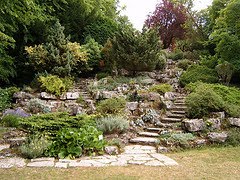
Caroline Stow-Crat thinks rockeries and crazy paving are “suburban”. And as for gnomes! But “the earliest gnomes arrived in Britain during the 1860s at Lamport Hall in Northampton where they inhabited a large rockery.” (Museum of Garden History website) She also despises chrysanthemums (which the Definitelies call "mums").

Why the fear of suburbs? All English houses aspire to be a country house with grounds, but in the suburbs there is only room for a strip at the front and a patch at the back. Even in cities, Victorian terraces were built with a strip separating them from the pavement. Today the strips are home to dustbins and overgrown Victorian shrubs (cotoneaster, privet, spotted laurel) selected more for their resistance to soot than their beauty - if they haven’t been turned sensibly into parking spaces. According to the Evening Standard (Jan 30 08), “suburbia is the most popular residential location of choice for about 60 per cent of households”.

Samantha Upward takes country house Sissinghurst or country opera venue Glyndebourne as her gardening model, despite having only 30 feet of back garden. She tries to reproduce an all-white garden, or crammed herbaceous borders. Primary colours are out. She thinks it’s suburban to tarmac your drive (gravel’s OK), and fulminates against those who concrete over their front gardens to create a parking place - nowhere for rain to soak in, we’ll all be under three feet of water in a few years. She doesn’t know whether to create a Mediterranean/ Dungeness dry garden to save water or plant a lot of rushes and watermint and wait for the floods.

If Samantha lives in the city she creates a jungle in the back yard with several large sculptures. She can’t have anything variegated, unlike Eileen and Howard Weybridge. Shrubs in clashing colours (robinia and copper beech) surround their Orpington home, where Virginia creeper only partly conceals the pebble-dash. Their patio is paved in York stone and somewhere there’s a bird bath or sundial, or both. They go so well with the concrete shepherdess. Sam bans shepherdesses and cupids, but her sculptures (by living artists) are just as sentimental in their own way.

If you’re the Countess of Northumberland you can do whatever you like and have a treehouse, giant waterslide and poison garden - but there was an awful lot of huffing while work was in progress at Alnwick (pronounced “Annick”).

There’s a snobbery of rose varieties: they have to be old roses from the right suppliers. (Pale pink and rumpled, with a sweet scent, they’re like 30s underwear.) Jen Teale has hybrid teas roses called Ena Harkness and Waltztime, scentless and firmly scrolled, and orange or salmon-pink (the colours of mid-60s lipstick, which is probably when they were bred). She also has a shaved lawn with no moss or weeds (Samantha sneers at people who cut their grass too short). Jen used to have either a clump of pampas grass or a laburnum in the centre of her lawn. Christine has a water feature and solar-powered garden lights. Both are common because electricity in any form (it powers the water feature) is unnatural. She also has decking, herring-bone brick paths and a circular patio in the centre of the back garden. And a brick-paved drive. When she bought the house she cleared the garden of any plants that were growing there.

Some Weybridges have a Spanish colonial mansion outside Haslemere with green curved roof tiles and wrought iron balconies. The grounds were laid out c. 1920 by a follower of Gertrude Jekyll and incorporate a small wood and lots of vivid rhododendrons and azaleas. Otherwise, or as well, Eileen has a mature monkey puzzle tree (araucaria), and (if she lives in the West Country) palm trees. In the 60s she had a vast lawn with a small heather garden, or a collection of dwarf conifers, at the end. In fine weather she relaxes in a padded 3-seater "swinging hammock".

The Nouveau-Richards’s garden is mainly oceans of lawn that comes right up to the house with no shade trees or shrubs – They’re very proud of their “landscaped” grounds. “Landscaped’” means cleaned up, tidied and shaved - hoovered, like the house - with trees dotted neatly about and maybe a bright blue pool with carefully selected white rocks around it. It’s wipe-clean nature. Mr Nouveau-Richards still mows the grass using a sit-on lawnmower.

There’s a deck or patio with chairs, seed-packet sun loungers and umbrellas huddled near the house, a tennis-court over here, and a wishing well plonked in the middle of a field-size lawn. It’s not for the agoraphobic. Somewhere in the middle distance there’s an elaborate kid’s adventure playground cum tree/wendy house with pointed gables that’s much more attractive than the McMansion itself.

In the front there’s an area of gravel the size of a football pitch for all their friends to park, with a ten-car garage at the side. (There must be firms selling décor to the superrich, but why has no one persuaded them to lay out their grounds in imitation of Versailles? It’s kinda disappointing. They could at least have herbaceous borders full of canna lilies and clashing bedding plants. Apparently they’re now buying Zen gardens… or being sold them.)

More here, and links to the rest.

Sunday, 14 November 2010

What Your Decor Says About You


They have a wine chiller, an espresso machine and his-and-hers TVs in their bathroom. uglyhousephotos.com

Michael Gove on Rosie Millard on Radio 4 being taken round a gazillionaire’s mansion, Times April 22, 2008: “...she was manifestly horrified by one, dominant, factor about the décor. Rosie had clearly been prepared for a vulgar display of ostentatious wealth, all gold taps, Swarovski crystal and white leather sofas. Instead, to her obvious disappointment and regret, everything was beige... The agent explained that the clientele with an interest in this place had grown used to living out of suitcases in five-star hotels, where every room is a lighter shade of beige, and they had come to associate that gentle colour scheme with luxury. Good taste even. To my ear, Rosie seemed quite moved on behalf of those in thrall to this delusion. The poor dears, condemned to thinking beige tasteful. How grimly, corporately, homogeneously, internationally, airport-loungely, bankerishly dull... beige is the colour not so much of bad taste as of no taste.”

The Stow-Crats have a drawing room (short for withdrawing room which was where the ladies “withdrew” after dinner so that both sexes could have a comfort break). Upwards have a sitting room, Weybridges and Teales a living room. Only airports and hotels have lounges. The ubertrendy Upwards have a flexible living space on the semi-mezzanine (their bedrooms are in the basement). They think this unconventional layout is fearfully “witty”.

The Nouveau-Richards’ house has huge rooms with space for several leather suites. There is nothing personal in sight. The fitted carpets are hoovered within an inch of their lives. It’s like a very upmarket B&B. There’s a vast marble-tiled hall with grand staircases curving up on either side and a huge sculpture dead centre. This room is used for nothing. The NRs buy old portraits and pretend they are of their own relatives. They – and the Definitelies – have a horseshoe-shaped sofa, which would be rather cosy.

Sam goes on living like a student for far too long. (According to Katherine Whitehorn we all think we belong with the group about ten years younger than us.) She aspires to the upper-class rotting-silk, antique-furniture, everything-covered-with-dog-hair look, but you need space for that. When she has children the toys and tiny clothes join the general clutter of laundry baskets on the sofa and catfood by the sink. Art by the children is bluetacked up next to posters of polar bears and aerial views of endangered rainforests and they all get a bit grubby and dog-eared. Her hall is full of bicycles and boots and the banisters are permanently draped with children’s pink duffel coats. In the 80s Sam rag rolled and sponge painted her walls in purple or lime. It was like living inside a boiled sweet. She covers her chairs and sofas with nonmatching “throws” instead of cleaning them. She moans a lot about people who install UPVC windows in period properties.

The Definitelies throw double-sided fake fur rugs on their beds. They also have a corner sofa plus coffee table, or a horseshoe one in black leather, plus a ceiling fan, a black shag pile carpet, an onyx table and a lifesize ceramic cheetah.

Some Bohemian Upwards add stuffed unicorns, dressmaker’s dummies and dried hydrangeas to the bicycles and coats in their halls. In the 70s, Arkana Nightshade painted her walls dark chocolate to set off her collection of antique lace garments and ostrich feathers in vases. The lace got dusty and brittle and the feathers were eaten by moths. She threw it all out and went in for feng shui. She offers to feng shui Sam’s life for a reduced fee, but Sam is terrified of becoming too tidy and Weybridge.

Sam and Caro Stow-Crat have open fires involving endless faff with coal, logs and rolled up newspaper, though the result is lovely. Sam may have a wood burning stove. The NRs have a hole-in-the-wall fire with (gas) flames coming up through a pile of pebbles. Now everyone’s got central heating, the Teales and Weybridges don’t need their coal-effect electric fires any more and either put the telly in the old fireplace or fill it with racks of wine bottles, or arrangements of fir-cones (which is what the Victorians did with theirs in the summer). The Definitelies have a wall-mounted, flat-panel, real-flame-effect number that emits heat as well. Or they have an “electric fireplace suite” (or just “electric suite”), that includes fireplace, mantel and integral electric (flame effect) fire. You can even get one that looks like a wood-burning stove, to the fury of the Upwards. Sam would call it a “mantelpiece”, with a slight shudder because she thinks there was some stricture in Nancy Mitford’s Noblesse Oblige. (It specifies “chimneypiece” – probably in reaction to vulgarly elaborate Edwardian overmantels with many brackets and shelves. Surely due a revival.)

Caro and the N-Rs have chandeliers, and so do the Definitelies, who bought theirs in the Woolworths closing-down sale. The N-Rs have theirs cleaned by a specialist company, and also hire art students to hand-paint their wallpaper and murals. Caro’s chandelier is in one of the state rooms she never uses, with each crystal tied up in muslin. It has never been converted to electricity. Every few years she takes it to bits and washes each crystal. She can give you tips on cleaning marble fireplaces, too.

Sam can’t have anything fitted except her kitchen and possibly not even that. She buys a dresser and a table and a Belfast sink (ripping out old 70s units) and hangs pans from hooks on the walls. She either strips the dresser or paints it white. She complains that people never cook in their “state-of-the-art” kitchens (and besides they cost £10,000). All her equipment is either bought in France (made of enamel to a design nobody’s changed for 50 years because there’s no need to) or in antique shops (also enamel, but cream/green rather than blue/red). She likes blue and white striped Cornish ware, or green Denby ware. Upwards have always loved hardware shops, maybe because the products are generic and never change. And because they love working class paraphernalia - but only when it’s 50 years out of date.

The Nouveau Richards have a fitted kitchen with many too many, too low cupboards, and “worktops” that you can’t do any work on because you’d hit your head on the cupboards. They have an “island” instead of a kitchen table. The Definitelies have black granite worktops and a breakfast bar.

Caro wonders: If you have a sitting room with an open fire, where do you put the television? Most people put it next to the fire. And what do you put it ON? A cabin trunk? A specially made low table? In the olden days, you put it in a separate room (and hotels had a “television room”).

Neither Sam nor Caro can use coasters (small, rigid mats you slip under people’s drinks or teacups to save your furniture). Caro leaves magazines on her furniture for people to put drinks down on. Sam doesn’t care, or else all her furniture is so covered with nicknacks, toys and old coffee mugs that there’s nowhere to put anything down anyway.

Eileen Weybridge has a set of coasters that matches her table mats: Indian red or forest green framing 18th century hunting scenes. She has large rooms with acres of pale, short-haired fitted carpet. Sam wonders how on earth she keeps it clean – but then Eileen is disciplined and efficient, and probably has a cleaning lady. The furniture is new repro, very shiny. Safe, unexciting pictures may include a bad oil or pastel portrait of Eileen or her daughter, or a meticulous painting of elephants. In her kitchen Eileen has a red Aga, and linen teatowels printed with unreliable legends about places she’s visited on holiday, or “old Cornish prayers”. She keeps her biscuits in a barrel, Sam keeps hers in a tin (that probably once held a gift assortment), and Caro keeps hers in a cream and green tin marked “biscuits” that’s been in the family for 75 years. The ubertrendy Upwards have the same tin, but it’s from a boutique which bought it at a boot sale.

The Teales have leather coasters printed with wolves — they collect Lupiana. They have wolf posters, wolf mouse mats, Howling Wolves cushion covers and a Running Grey Wolf Credit Card Case, and Jen embroiders large pictures incorporating a wolf, a bare tree, a crescent moon and an Indian brave. Other Teales collect fairyana, or - if male - cast their own metal-effect Dungeons and Dragons characters.

The Teales did up their house in the 80s and never moved on - or else the interiors shops in their area never moved on. Every room has a dado: stripes underneath, flowery border, little blobby pattern above in shades of orange, jade, brick, grey, pink, lemon. The bathroom has a tiled dado. They have the last tart’s knicker blinds surviving in the wild. Their windows have elaborate draped pelmets. Though thanks to strenuous efforts by TV makeover shows this stylistic elephant’s graveyard is being obliterated by magnolia paint and very, very neat minimalist interiors.

Caro's mother has photographs of the royals in silver frames on the grand piano. Mrs Definitely has all her family in plastic cubes on the telly, or in a multi-picture frame, or in non-matching frames on the mantelpiece. Upwards don't display family photos. Out of sight out of mind – they just forget what family members look like.

Successful Teales live in new-build flats or converted warehouses in Docklands. Their flats are feng shui’d to the (non-existent) coving and contain practically nothing apart from rubber rocking chairs, modular foam sofas and glass tables. They have state-of-the-art kitchens (with islands, extractor hoods, granite and brushed steel) that they never cook in. They have a terrace with decking and bamboos in pots - they came with the flat.

Why are posh accents described as “cut glass”? Cut glass is faceted like a diamond, and cut with a diamond wheel. If you can’t afford the real thing, you buy a moulded imitation. But when the real thing becomes cheaper and moves downmarket it is shunned by the middle classes. Also it’s too shiny for them. Stow Crats carry on using the cut glass bought by their 18th century ancestors.
More here. And more here. And here. And here.