
Showing posts with label gardens. Show all posts

Saturday, 6 October 2018

In an English Country Garden


Those aren’t plastic flowers, those are “faux botanicals”.

Weybridges know the Latin names of house plants. Fiona Stow Crat gives hers nicknames. 

An Escape to the Country participant says his ambition is to have enough grass for a sit-on lawnmower.

No good house should have to suffer the indignity of being covered with climbing plants. It is architectural bad manners almost on a par with plastic doors and windows. (Letter to Times, May 2017)

I was once sternly told not to plant Russian vine in my garden – so I did, and it flourished. I couldn’t understand why my mother wouldn’t plant any beautiful, romantic Virginia creeper, found all around us in Surrey climbing up half-timbered Arts and Crafts villas. She also vetoed pampas grass (suburban) and my father outlawed nasturtiums (too orange), but she grew them anyway.

In the 70s a clump of pampas grass in the centre of your front lawn was supposed to signal the home of wife-swappers. (What did other wife-swappers do? Just come and ring your doorbell?) The pampas grass would be in the middle of a perfectly kept lawn in front of the house, with no fence or wall. This was thought to be American and hence utterly naff. If you didn't have pampas grass, you probably had a laburnum. (What happened to them? Health and Safety? The seeds are poisonous.) Laburnums were naff, as were any "weeping" trees including willows and silver birches. In fact silver birches were verboten whether they wept or not. According to Nicky Haslam, hydrangeas were posh in Edwardian times.

Garden no-nos from the Times 
Times writer Anne Treneman has inherited a garden – she bought it from someone called “Malcolm”. Unfortunately it contains:

pampas grass
Leylandii
hostas
poisonous plants
orange flowers

She also frowns on:
tiny Zen gardens
invasive bamboo
anything that grows too big (Don’t plant a Scots pine in a  suburban front garden)
climbers (that strangle your TV aerial)


To the Brits, horticulture is about the gardens of stately homes, not breeding disease-resistant bananas. Cecil Beaton (The Glass of Fashion) makes the point that flowers were part of your interior décor, and you renewed them every week, or every few days. If you had “grounds”, your flower garden was designed to produce flowers to decorate the house. Per Nicky Haslam (Redeeming Features), this is called the “cutting garden”.

Until the mid-60s, women still “did the flowers”. In a large country house, either the wife or one of her daughters had the task of picking the flowers and taking them (in a wooden trug basket) to the “flower room”, where there was a big sink, and vases on a slate shelf. Here she arranged bouquets for the drawing room, dining room and hall, and possibly guest bedrooms and her own.

In the 50s and 60s women went to flower-arranging classes (a relative was very witty about being told to put “blooms” in a “container”). They dabbled in ikebana, and read Constance Spry. Post-war domestic writer Ethelind Fearon (The Reluctant Gardener) advises on which plants to grow and how to turn them into “arrangements”. This sometimes involved clipping leaves into more aesthetic shapes. And then women got jobs, and we did without flower arrangements, or substituted trailing variegated ivy (60s) or spider plants (70s).

When Upwards, forced out of inner London, move to Stratford or Walthamstow, all they can find are houses with “state of the art” kitchens and gardens that have been “cleared”. They immediately start making the garden look wild and untidy again. If they can afford it, they “rip out” the gleaming cabinets and replace them with dangerously rocky 50s “kitchenette” larders and a pine table. If they’re really well-heeled, they pull down the extension and turn it back into a patio.

Monty Don in the Times on John Seymour’s self-sufficiency books: Nobody apart from “a few bedraggled hippies on wet Welsh hillsides” really wanted to fend for themselves. (Self-sufficiency also required you to use your children as slave labour. Though didn't the Downton Abbey inhabitants live off their estates? They were self-sufficient in venison, peaches and everything else – easy if you have enough land and can pay gardeners and farm-hands.)

‘Well, well,’ said Colin. ‘Some front garden!’ 

It was indeed a model of surburban perfection in a small way. There were beds of geraniums with lobelia edging. There were large fleshy-looking begonias, and there was a fine display of garden ornaments — frogs, toadstools, comic gnomes and pixies. 


‘I’m sure Mr Bland must be a nice worthy man,’ said Colin, with a shudder. ‘He couldn’t have these terrible ideas if he wasn’t.’
(Agatha Christie, The Clocks)

More here, and links to the rest.


Wednesday, 20 May 2015

Come Into the Garden Again


“Cut out all affectations, such as small bridges... human figures, china animals, glass ornaments, model houses, windmills etc.” advised the London Gardens Society of the 1930s.

When bedding plants (huge beds of one colour) slipped from Queen Victoria's house Osborne to public parks, they became “vulgar and garish”, says Alison Light in the London Review of Books reviewing The Gardens of the British Working Class by Margaret Willes. (Now despised, calceolarias, salvias and begonias were originally exotic imports that needed raising in hot houses.) Oyster-shell edging looked right in a Tudor knot garden, but not in a suburb. (Light repeats the canard that working-class people used most of their garden for growing food – not according to Charles Dickens, who described a village of wooden shacks, each with its outside seat in a “bower”. And hang on, what about all those paintings of cottage gardens?)

Quick-growing cornus provide a dark canopy in high summer – but be sure to avoid the garish pink varieties. I have used pink flowered forms in Japan, where the sugariness sits better with a Hello Kitty sensibility, but I wouldn’t use them here. Stick with the simplicity of cream and you won’t go far wrong.
 (Dan Pearson, Observer July 2014 Love the way he uses "simple" to mean "tasteful".)

Wavy fences are suburban (and 30s). Anathema to Upwards are suburban roads lined with pink flowering cherry and yellow forsythia in front gardens. That strip of land is supposed to keep the world at a distance – they don’t like all these Weybridge personalities coming right out to greet them. You are supposed to read a front garden as really being acres of parkland with deer, sheep and 500-year-old oaks, even if it is only a clump of cotoneasters and spotted laurel. Samantha Upward flinches at talk of the Britain in Bloom competition: all hanging baskets of lobelias.

Beautiful modernist houses (like Farnsworth House) are always in woods. No garden, just a clearing or lawns, with trees. It would be a crime to surround one with bedding plants or herbaceous borders. (But where’s the drive? How do you get there? And where do you park?)


You can get an “outdoor bonfire” (like gas logs). You may call it a “fire sculpture”, but who installs one of these? Surely only the Nouveau-Richards. A circular deck surrounded by a Richard Long ripoff (cemented together), and with a dining area in the middle is beyond naff. A “fire pit” is a fire wok, and you can get them in the style of Andy Goldsworthy. But a circular outdoor conversation pit with one of these in the middle would be rather cosy.


Domestic goddess Martha Stewart has a 153-acre farm in Bedford, New York – including horse paddocks, cutting gardens, a clematis pergola and “long allée of boxwood”. Good for her – big bare houses look so stark. The rich are still surrounding their mansions with a few timid plants, a table and chairs set huddled close to the house on a tiny patio, and vast areas of gravel (in front) and grass (at the back). What do they do on the grass – apart from mow it? With all that money, why don’t they turn their grounds into an adventure playground for adults? Or a maze? Or a treasure trail? Or a series of “rooms”? Or a forest?

At the least the houses need a flower bed and a flagged path all round. And a flower bed or small box hedge encircling the lawn. And features in the garden – paths, ponds, sundials, fruit trees, shade. They could spread themselves – build a bigger terrace, call it a parterre, put in some steps, a pergola, a few vines, some trees, fountains, statues… But I suppose proper stately home gardens require a staff of gardeners.

It was a green tunnel through the wood which opened suddenly upon a garden of rampant roses. Behind that, out of ample robes of roses and all kinds of clematis and jasmine, oriel windows gleamed... (A Clue for Mr Fortune, HC Bailey, 1937)

In Georgette Heyer’s 30s mystery No Wind of Blame, a  a vulgar ex-hotelier is aiming for the country house style, but doesn’t really like the “wild” garden with its rhododendrons and azaleas. He prefers the neat formal garden and “carriage sweep” at the front of the house.

Between King’s Cross and Highbury there are backwaters of huge Georgian houses that must be worth a million or two. The associated gardens all feature laburnums and wistaria.

In large country houses, flowers were grown in hothouses and flowerbeds to decorate the house. The lady of the house, or one of her daughters, arranged them herself. The idea slid down the classes, and Metroland grew roses and put them in rose bowls on occasional tables. Bowls of growing hyacinths were also popular, and hydrangeas in the garden. Metroland devised new types of flower vase: the bud vase for a single rose, little horseshoe-shaped containers in moss-effect pottery for primroses. And now we’re left with a lot of vases of various periods that mainly hold commercial bouquets we have been given for mother’s day.

The Times (May 16) has a tip for keeping the birds off your grass seed – use bunting.

More here, and links to the rest.

Monday, 16 December 2013

Come into the Garden


Walter Fish wanted paths, lawns and a symmetrical line-up of dahlias. Margery wanted Jekyll-like drifts, wild flowers and informality. Walter laid his lawn with a very narrow strip of earth down one side where he said she could have flowers as long as they didn’t encroach on the grass. He banished wisteria…
London Review of Books Dec 2013 on gardening writer Margery Fish. When Walter died, she got her garden.

My father sneered at next door’s garden because they had crescent-shaped beds with sharp edges, as in a park. “Half of us get upset if next door’s garden is a jungle”, says the Daily Mail. The other half get upset if next door’s garden is too neat. (June 2012) Or if someone in the street goes all Zen.

Vita Sackville-West (of Sissinghurst fame) sneered at writer Leonard Woolf for putting statuary and a water garden next to a cottage, like a mini-Versailles. Virginia Woolf was caustic about his “leaden cupids”.

The Royal Horticultural Society Encyclopedia has some hilariously snobbish gardening advice: A crazy paving path does not go with an 18th century cottage; “informal” planting should all be the same colour. And “...make sure the furnishings do not ruin the effect. A wrought-iron bench, for instance, might be too elaborate for many gardens, whereas a simple wooden one would rarely jar… A decorated Italian urn is probably too grand for an informal, suburban garden, even if planted with humble daisies… Slight deviations [from original concept] will create a sense of clutter and all your planning will have been in vain…. Avoid crowding the basic pattern with a 'liquorice allsorts' sprinkling of plants.”

Very trendy Rowena Upward has a genuine cast iron “rustic twig” Victorian garden bench, circa 1850.

Granset’s advice on moving to a village warns against immediately cutting down your trees or putting up a two-car garage.  And don’t try to join everything – but do turn up to all the events.

Upper-middle-class Samantha Upward encourages spiders to keep down flies, middle-middle Eileen Weybridge runs screaming, lower-middle Jen Teale thinks spiderwebs are so untidy, Sharon Definitely sprays bugs with Insectrol – which Sam could never do because a) it’s cruel b) it damages the environment and c) CFCs are destroying the ozone layer.

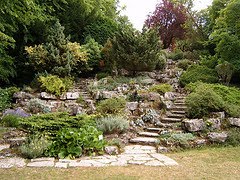
Rockeries and dahlias are beyond the pale (though dahlias may be making a comeback as some gentleman is growing rare varieties). People grow them on allotments, says gardener Alan Titchmarsh, adding “don’t spurn the dahlia – it’s worth a second look”.

In Victorian days, stately homes had acres of greenhouses for raising bedding plants: these were planted in geometric, brightly coloured arrangements by teams of gardeners. The plants were replaced as soon as they were “over”. The bright colours are somewhat out of date (though this kind of planting can still be seen in the centre of roundabouts, at the seaside and in some London parks). Unfortunately, the suburbs copied, and by the early 20th century bedding plants were flourishing in Metroland, the Arts and Crafts suburbs beloved of John Betjeman. These days, bedding plants are bought at garden centres, not raised in your own greenhouses, and are thrown out when they cease flowering. Samantha finds the whole process unnatural. She likes the new style of planting, with tightly packed alchemillas, Chinese grasses, purple loosestrife and herbs.

Upwards can’t have a garden that’s “overlooked”, and Sam turns up her nose at those who turn an entire small back garden into a deck, trampoline, swimming pool or carp pond.

What gadgets can you have in your garden? Is a Kadai fire bowl posh, but a pizza oven nouveau? An outside area with Flintstone walls, an outside hearth and a hot tub is very vulgar indeed.

More here, and links to the rest.

Thursday, 25 November 2010

Come into the Garden


Trellis is "twee" and timber garden sheds are "flouncy". Guardian Sat June 28 08

For these berserkers it's not enough to mow the existing grass and prune overgrown trees, and just live there. In some anal need to banish nature, they'll chop down the trees, take down hedges that gave privacy to the neighbors... banish anything that might attract a bee or caterpillar, rip out everything but chemically tended grass, and throw Round-up around like salt on popcorn. I'm not talking about renewing an old garden, or making space for a new one but of deliberately disappearing any semblance of a garden. They are not NON-gardeners - they are ANTI-gardeners. gardenrant.com


Caroline Stow-Crat thinks rockeries and crazy paving are “suburban”. And as for gnomes! But “the earliest gnomes arrived in Britain during the 1860s at Lamport Hall in Northampton where they inhabited a large rockery.” (Museum of Garden History website) She also despises chrysanthemums (which the Definitelies call "mums").

Why the fear of suburbs? All English houses aspire to be a country house with grounds, but in the suburbs there is only room for a strip at the front and a patch at the back. Even in cities, Victorian terraces were built with a strip separating them from the pavement. Today the strips are home to dustbins and overgrown Victorian shrubs (cotoneaster, privet, spotted laurel) selected more for their resistance to soot than their beauty - if they haven’t been turned sensibly into parking spaces. According to the Evening Standard (Jan 30 08), “suburbia is the most popular residential location of choice for about 60 per cent of households”.

Samantha Upward takes country house Sissinghurst or country opera venue Glyndebourne as her gardening model, despite having only 30 feet of back garden. She tries to reproduce an all-white garden, or crammed herbaceous borders. Primary colours are out. She thinks it’s suburban to tarmac your drive (gravel’s OK), and fulminates against those who concrete over their front gardens to create a parking place - nowhere for rain to soak in, we’ll all be under three feet of water in a few years. She doesn’t know whether to create a Mediterranean/ Dungeness dry garden to save water or plant a lot of rushes and watermint and wait for the floods.

If Samantha lives in the city she creates a jungle in the back yard with several large sculptures. She can’t have anything variegated, unlike Eileen and Howard Weybridge. Shrubs in clashing colours (robinia and copper beech) surround their Orpington home, where Virginia creeper only partly conceals the pebble-dash. Their patio is paved in York stone and somewhere there’s a bird bath or sundial, or both. They go so well with the concrete shepherdess. Sam bans shepherdesses and cupids, but her sculptures (by living artists) are just as sentimental in their own way.

If you’re the Countess of Northumberland you can do whatever you like and have a treehouse, giant waterslide and poison garden - but there was an awful lot of huffing while work was in progress at Alnwick (pronounced “Annick”).

There’s a snobbery of rose varieties: they have to be old roses from the right suppliers. (Pale pink and rumpled, with a sweet scent, they’re like 30s underwear.) Jen Teale has hybrid teas roses called Ena Harkness and Waltztime, scentless and firmly scrolled, and orange or salmon-pink (the colours of mid-60s lipstick, which is probably when they were bred). She also has a shaved lawn with no moss or weeds (Samantha sneers at people who cut their grass too short). Jen used to have either a clump of pampas grass or a laburnum in the centre of her lawn. Christine has a water feature and solar-powered garden lights. Both are common because electricity in any form (it powers the water feature) is unnatural. She also has decking, herring-bone brick paths and a circular patio in the centre of the back garden. And a brick-paved drive. When she bought the house she cleared the garden of any plants that were growing there.

Some Weybridges have a Spanish colonial mansion outside Haslemere with green curved roof tiles and wrought iron balconies. The grounds were laid out c. 1920 by a follower of Gertrude Jekyll and incorporate a small wood and lots of vivid rhododendrons and azaleas. Otherwise, or as well, Eileen has a mature monkey puzzle tree (araucaria), and (if she lives in the West Country) palm trees. In the 60s she had a vast lawn with a small heather garden, or a collection of dwarf conifers, at the end. In fine weather she relaxes in a padded 3-seater "swinging hammock".

The Nouveau-Richards’s garden is mainly oceans of lawn that comes right up to the house with no shade trees or shrubs – They’re very proud of their “landscaped” grounds. “Landscaped’” means cleaned up, tidied and shaved - hoovered, like the house - with trees dotted neatly about and maybe a bright blue pool with carefully selected white rocks around it. It’s wipe-clean nature. Mr Nouveau-Richards still mows the grass using a sit-on lawnmower.

There’s a deck or patio with chairs, seed-packet sun loungers and umbrellas huddled near the house, a tennis-court over here, and a wishing well plonked in the middle of a field-size lawn. It’s not for the agoraphobic. Somewhere in the middle distance there’s an elaborate kid’s adventure playground cum tree/wendy house with pointed gables that’s much more attractive than the McMansion itself.

In the front there’s an area of gravel the size of a football pitch for all their friends to park, with a ten-car garage at the side. (There must be firms selling décor to the superrich, but why has no one persuaded them to lay out their grounds in imitation of Versailles? It’s kinda disappointing. They could at least have herbaceous borders full of canna lilies and clashing bedding plants. Apparently they’re now buying Zen gardens… or being sold them.)

More here, and links to the rest.