Wednesday, 3 August 2022

Beat the Heat


A photosensitive friend reports that, when she carries an umbrella on a torrid sunny day, she gets barracked: “Oi, look, she thinks it’s raining!” (That's Audrey Hepburn in the picture.)

In the sun, my fair-skinned mother wore dark glasses, a hat, a scarf, and a long-sleeved shirt and didn’t care about being thought eccentric, but she was mortified when I wore white gloves to protect my sunburned hands at an al fresco lunch party. (She was still bringing it up decades later.)

Will global warming mean the Brits carry parasols and flutter fans? Or will they just be too embarrassed? Whenever I use a fan, on a bus or at a concert, people nearby say “Oh, that’s lovely! Send it this way!” But they never pick up a fan themselves. It may need a first-person article: "I carried a parasol and fanned myself in public and survived." 

For years we thought that the old air conditioner in our room was inoperable because there was no control for it until last summer when we did a bit of a clear-out and found the on-off switch behind some files. It works fine. We sat sweating through summer after summer. (Lawyer Adam Wagner)

In a 70s office block (now demolished), we sweltered. We couldn’t open the huge, heavy windows as there was no way to stop them slamming shut, and besides, all our papers would get blown about. We had electric fans, and sprays for watering the plants – we directed the spray at the fan – bliss! We also ate lunch on the roof.

Annual hot weather reminder that if you’ve got sash windows and open them equally at top and bottom you can enjoy some Victorian “air conditioning” that ventilates and removes heat. (@jester Jun 9 2023)  

The Victorians also planted shady bowers – and created water features. They wore broad hats and carried parasols. And they put their hair up.

Awnings fixed above all your windows create a cool temperature inside the room. And they protect your shop-window display from the sun. Time to bring them back! (Via @DarrenMcLean_uk, 2023)

Shutters will do the same. Or fix a foil blanket over the whole window, says Morning Live.

There are several books on “dry gardening”, such as Gardening in a Changing Climate by Ambra Edwards. Plant shrubs and trees for shade, and install beach umbrellas, a gazebo and a large paddling pool. Hydrate plants with “grey” water – bath, washing-up.

Paper fans can be bought online, or in Chinatown. Chinese paper umbrellas are available online. Or  why not a colourful golf umbrella? Or, if you’re a real rebel, one with a firm’s logo? Or a child’s brolly with cat’s ears? To find something like a traditional parasol, try searching for "pagoda umbrella" or "steampunk umbrella". You can get a long-handled parasol from Move Dance. They have lace umbrellas too, as do bridal suppliers. Hello, street-corner purveyors of shawls, hats and umbrellas – why not stock some parasols?

Men: instead of 3/4 cargo shorts worn at half-mast, why not a cool, floor-length kaftan? And get a short back and sides, shave your head, or sport a man-bun.

Women: an updo is cooler. As are short hair and a cotton sports or plunge bra. Thank goodness buffet dresses (long, big, loose, ruffled) are popular – or were a few years ago. A long, drapey skirt will also act like a fan and cool your legs.

All genders: go for loose cotton or linen. 
 
Wet towel on the back of the neck. 
 
Bathe bare arms and neck in tepid water and sit by the fan.
 
Do the same with an aromatic wet wipe

For the home, current advice is to install outdoor shutters (shut them for coolness in summer, warmth in winter). Also to shut windows and close curtains... I’ll still be opening all my windows – I’m lucky, I’m five floors up. I’ve been securing them with tie-belts – “casement stays” are not very effective. It makes sense to close curtains where the sun is streaming in – and it’ll save your upholstery and pictures from bleaching.

Put a plastic bottle 3/4 full of water in the freezer. Take out when frozen and scatter several around the house. Or position in front of the fan.

Put a tray full of ice cubes in front of the fan.

Fill the bath with cold water and leave it – you can splash or paddle occasionally.

Hang wet sheets over windows – or dry sheets for shade.

Leave internal doors open – and shut them in the winter.

Open the hatch into the attic and the hot air will rise into it. If the attic has a window, open it.

Reuse that Victorian foot-warmer - fill it with cold water and ice. Or use it as a foot bath.

Don’t keep your crystal ball on a windowsill – it can refract the light and even cause a fire! Watch out for magnifying mirrors, too.

Drink a lot – water and fruit juice with ice. Keep a covered jug or bottle of water in the fridge. Or a metal water bottle. So what if the BBC tells you to do this several times a day.

Architects, builders: design large windows that can open (and be securely propped open). On both sides of the building, for through draughts. Install natural aircon in the form of windcatchers. If steel-and-glass offices and flats can have large windows, why can't new houses modelled on Victorian cottages? And for large public buildings, three times as many women's toilets as gents', and some gender-neutral cubicles. When a venue has to employ "toilet queue co-ordinators", you know something is wrong.

Councils – plant trees. (Happening, 2024.)

Shops – install awnings.

Update 2025: We’re going through a strange moment with airconditioning. Government says new builds shouldn’t have it, because those who can’t afford it will feel hard-done-by. They don’t put it like that, they waffle about “inequality”. Meanwhile Guardianistas can hardly bring them selves to touch it. Something sinful about being comfortable. And it’s technology – vulgar, common, you can’t get a unique artisanal one hand-carved out of sustainable bamboo. Everyone gets the same. And it’s American. The British middle classes went through all this over central heating in the 70s. They also won’t take practical steps like fanning yourself, or even using electric fans. These came with the usual superstitions: “Don’t stand right next to it it’ll make you hotter”. A Guardianista in mid-rant confesses she has a cheap mobile aircon unit, “But we use it perhaps ten times a year!”. (Yes, but I didn’t inhale.)

In 2026 Americans are tweeting that the weird Europeans won't use aircon. And we don't have any ice cubes! (It's true some older Europeans think that a "courant d'air" (draught) is deadly.) Other Europeans, even those in planning departments, will suggest anything but aircon because "aircon is American.)

And there was a moment about 30 or 40 years ago when Upwards weren't sure they were allowed electric fans in the home. Too direct, too obvious, too practical, too bish-bash-bosh and terribly unspiritual. And unromantic! Many Upwards don't dare fiddle with the aircon in the meeting room or exercise class. They have polite squabbles about "if the fan is ON, we need to SHUT the doors because..."

Rowena installs a combination fan and ceiling light.

More here, and links to the rest.


Wednesday, 29 June 2022

Art School: What I Did Next


So, what did I do next?
After a rotten non-education at an expensive boarding school, I did another O Level and A Level at a tutoring establishment. And then I went to Camberwell art school in South London, aged 17.

From the age of about ten I’d been “going to art school”. My mother wanted me to relive her days at Chelsea Art School in the 30s and 40s, with boyfriends, parties, lunch at the Savoy and tea at the Ritz. 

When I was 15 or 16, she took me round to see friends from her art college days. I wore a frilly white blouse and a pink tweed pinafore dress she’d made me, and they were polite about my work. I was sent to talk to them on my own. I had nothing to say. At the official interview for Camberwell Art School they asked me what I read. I said “George Orwell and the Evening Standard”. I didn’t know I was supposed to say something like “Leonardo’s notebooks”. We were given a reading list before the first term and I got my parents to buy all the books (including Leonardo’s notebooks), and I read them. I loved Kandinsky’s Concerning the Spiritual in Art and later wrote an essay based on it that impressed the tutors.  

We arrived for the first day bringing work we’d done in the summer holidays. The paintings were pinned up on a wall, and one of the staff critiqued them one by one. He was a small man with a beard and a sneery, nasal voice and was rude about every single painting. He was keen that we shouldn’t paint “cottages with roses round the door”. One student had been “looking at something to do with hobbits and Tolkien”. (She had an innovative technique and didn’t really need instruction from anybody. She’s now a psychotherapist.)

During the Foundation year we were at least given something to do, even if it was make-work. We were sent to the V&A to copy what we liked, and then we came back to a converted school and made collages from our drawings. The tutor in charge used to go to the pub at lunchtime and come back and harangue us and punch us painfully on the arm – especially the female students. There was a little tea bar run by elderly ladies, and a Victorian stove that we gathered round occasionally. Life wasn’t wonderful, but we had no idea how much worse it was going to get. 

There was a canteen and a library at the college, but no common room. Students from out of town were found a rented room nearby – though one girl was housed in faraway Sidcup. She referred to the college as “this place” in a fed-up voice and left after the first term – I don’t blame her. There were no evening activities, apart the occasional film screening – just lectures and more classes. (The college is now part of a university with halls and a campus.) 

We were set to draw from life, and make studies of plaster casts of antique sculpture. It was the fossil of an approach that had once made sense. In the 19th century and earlier, wannabe artists assembled their studies into theatrical scenes of life in Ancient Rome, Biblical episodes or dramatic moments from Shakespeare. Or, like William Powell Frith, vivid scenarios on railway stations or at race courses. It was also good training for creating book covers, adverts and magazine illustrations – all of which had just been taken over by photography. The rationale had gone, but artists still labelled their works "Study of a Head" – not "Portrait of Doris".

After the Foundation Year came the Painting Course. At first, I didn't get in, but I think my mother pulled strings again. I cried when I was told I'd failed – why? I was already disillusioned, tired and fed up. 

What kind of art were they expecting us to produce? The staff loved the Camden Town Group, Walter Sickert and his townscapes, or the works of William Coldstream and the Euston Road School. Social comment was out, and they loathed sentimentality. They expected us all (including 17-year-old girls) to live and paint as if we were 40-year-old men. They wanted us to like the work of Soutine, who painted decaying sides of beef.

It was the late 60s, and the tutors were probably shuddering at memories of a genre that emerged when war artists, deprived of a subject, became embarrassingly mystical – see Evelyn Dunbar. Coldstream, and his follower and our teacher Euan Uglow (see picture), were both excellent painters, now rather forgotten. They left underdrawing and grids partly exposed, and reduced landscapes, still lives, fruit and people to flat planes and straight lines. 

We weren’t allowed to paint or draw anything we cared about. We weren’t allowed to make political statements, have opinions or convey emotion. We had to pretend people were no more interesting than a bunch of flowers or a cabbage. The tutors were keen on “objectivity” rather than “subjectivity”. They wanted us to look at what we were painting, not to make up what we thought it looked like. They hated anything “literary”, like the PreRaphaelites, who were having a moment. Paintings should be “painterly”. (I was delighted, a few years later, to read an article that called this a dead debate.) Other diktats? Don’t use a ruler, and “There’s no black in nature”. 

All the best artists have had a thing for pure black. (Christian Furr, Times 2019) 

The only portraits we were allowed to like were by Giacometti – ugly, unemotional. When we looked at art we weren’t allowed to comment on facial expressions or the story behind the picture.

Jane Rosenberg (court artist) trained in the 1970s, when figurative art was deeply unfashionable at art college. “Jane Rosenberg grew up on Long Island in New York and studied art at the University of Buffalo. It was the early 1970s and “abstract art was very in. My teachers always discouraged me from doing realism. They said it’s very passé.” She did it furtively. “I was a closet portrait artist. I would sit at home with a mirror and draw myself.” (Will Pavia, Times 2021)

They told us to “look at the work of X”, which meant “copy X because he’s someone we approve of”. They would never talk about painting techniques, or admit that you could just pick a method and try it. You might go for “squared, interwoven brushstrokes,” as art historian Richard Morris describes. Or you could “block in your masses and then add detail”, like any Victorian painter.

They wanted us to decide on some subject matter (only ever referred to dismissively as “the image” – we were probably meant to select it for purely formal reasons), come up with a technique, and produce a body of work which would be judged at the end of three years. But they never told us any of this. And it required us to decide on a course of action, and have the discipline to carry it out. I'd never done anything like that in my life. What's more, all the education they'd given us so far had been about process, not product.

Nobody mentioned that being an artist was a career, a profession or even a trade. The idea that anybody might buy our work was not on the table. My mother recalled that in her day they were taken on trips round art galleries to see what sold! These days students get seminars on marketing and being taken up by a gallery. (Start a movement, get in the papers.)

I worked on paper because I didn’t have a choice. I had no carpentry skills, had tried to make stretchers but failed miserably. Canvas was out. So were wood or Masonite panels: too heavy, expensive, large, and I didn’t know how to cut them. (Jerry Saltz, artist and art critic) 

We were all, including the girls, expected to hammer together and stretch canvases 6 foot by 6 foot. The only other option was to buy pieces of hardboard from a local wood yard where they'd cut them for you, but this was looked down on. We were supposed to go out drawing carrying paper pinned to a heavy board. We couldn’t do anything on a small scale unless on the Graphics course (it used to be called Commercial Art). We were told to buy a certain kind of portfolio – huge, heavy, cardboard, with no carrying handles. Small girls couldn’t even get an arm round them. On the first day we were advised against “some kind of plastic contraption” – light, with handles. In fact the tutors treated all students as if they were men. And then girls were marked down because their work was too small. I’ve thought this was unfair for 50 years. A student called Terry used house paint in buckets and created a vast painted surface several inches thick. I wonder what happened to him? (He brought in a pig's head and hung it up and painted it. (One day someone put a tape recorder in its mouth that played a laugh track on repeat as the head turned slowly in the air. I tried telling people about this, but they were theatrically uninterested.)

Another favourite was Julia, who worked in thin layers that she constantly overpainted, leaving some of the under-layers showing. Catherine created Abstract Expressionist studies of erupting volcanoes, and Debbie painted mantelpieces and their contents. She wrote up in her cubicle “You can change your life. Rilke”. I thought: “How ridiculous, of course you can’t.” 

For the first few weeks of the painting course we were set to depict Platonic solids (square, sphere, cone, pyramid) and meaningless containers: boxes, milk bottles, wine bottles – in grisaille, i.e. shades of grey. It was an exercise so dull and devoid of human interest that some students got fed up and left. Perhaps that was the intention. Many had sensibly gone back to Bolton after the first year. 

After the grisaille exercise we were each given a cubicle and pretty much left alone. There was no more need to collaborate with each other – or talk to each other. We worked in silence. If we chatted, we were shushed. There was no banter.

Once they stopped setting us exercises I had no idea what I was meant to do. It didn't help that we'd been told that "introspection is morbid". We weren't used to asking ourselves if we were happy, and if not, what to do about it.

We each had a tutor of our own and met with him from time to time. Mine decided that I was an upper-class party girl and was more interested in socialising and boyfriends than doing any work. I couldn’t disagree because I was so shy I couldn’t talk to adults. I must have seemed completely uninterested. Did he ever wonder what I was doing there?

He must have assumed that I knew that we were supposed to decide on a practice and a subject, and produce a body of work that would be assessed in three years' time. His job was probably to discuss my plans with me, and look for some kind of development or progress in technique and process. This is really the key. He must have thought I couldn't possibly be that naive – something that happened quite frequently later in my life. (People assumed I was lying, and tried to work out why, probably invoking Freud.)

We weren't given projects or tasks, or set to learn anything. Our Art History seminars were just discussions. Few facts were imparted, and no historical background. We were shown pictures and expected to respond. There was an older German student whose reaction to everything was, "Well, it's very graphic". I just had no idea what to do with myself all day. On the bus there and back, I read Lord of the Rings, the Gormenghast Trilogy, and Cecil Sharp's collection of Appalachian folk tunes.

Update: I've just remembered I used to illustrate those grim Appalachian ballads in black ink in small sketchbooks. One of the tutors even said "It's a nice little book". At least it showed I was doing something.

But I felt a complete failure: the glittering social life hadn’t happened, I’d never had a boyfriend, and I felt I had no friends. Over one Easter holiday I deliberately gave up hope that I’d ever have either. It was painful. But I did have friends – Penny, Liz, Sarah, Joan, Gillian, Catherine and Pam, a nice girl from Liverpool who liked CS Lewis and got married in a white lace catsuit.

Perhaps class had something to do with it. In the first year, the boys never talked to me or my friends. If they looked at us at all it was with an expressionless, unblinking stare. Were they put off by our accents? Or by our shapeless, paint-stained clothes? 

I burned out. Living in a bedsit didn’t help, either. I hated walking along streets alone. I couldn’t make the effort any more. I stopped speaking to people, so naturally nobody spoke to me. I thought life would be like that for ever. By the end, I only spoke in seminars. They were the only bearable part of the experience.

And I was deeply, deeply ashamed of never having had a boyfriend. It was the reason I couldn't get in touch with friends from school any more. This went on for years.

When not in a bedsit, I lived with my parents. From Day One, they never asked me what the other students were like, what I had done that day, who were my friends. At boarding school or university, their children were out of sight, out of mind – but they continued this policy when I was right there, day after day. I didn’t talk about my day-to-day life to anyone. 

And after being at boarding school from age 10, this was my first try at creating a social life from scratch. Nobody had told me it might be hard. The students from Bolton had gone to local schools and had at least grown up with a bunch of friends, but middle-class children were always being sent off to cope with new situations entirely on their own, without any briefing or debriefing. And hang on a minute – my mother had known me all my life. I’d always been painfully shy – why did she think I’d suddenly turn into a social butterfly?

Years later I bumped into Charlie, a fellow student, and compared notes. One night he was so desperate he walked home from his bedsit to Hertfordshire. I used to walk to college to reduce the hours I had to spend there. Louie walked out of London just to see if she could escape. (She left and went to America.) 

We weren’t used to taking an audit, wondering if we were happy, and if not why not. On rare occasions, we tentatively shared our feelings, but we had no idea what to do about it. We were 18 or 19. It was the late 60s, we were supposed to be achieving bliss

Eventually I too decided to leave. But I didn’t dare tell my parents – I was back living with them. For a whole term, I left the flat in the morning, and came home in the evening, pretending I was still at college. I trekked long distances, went to free galleries, took long bus rides, read. One day I bumped into one of the teachers. He said: “I’ve been wanting to talk to you.” I said: “I’ve been wanting to talk to you too”. So we made a date and looked at my pathetic “work”, which he disparaged severely. But we agreed it would be best if I left. However, I couldn’t just walk out – I had to endure an excruciating official exit process, which included laying all my productions on the floor in front of a committee of sneering men with beards. I deliberately dressed badly, with dirty hair, a too-small green dress and magenta lipstick. Nobody could think what else I might do apart from “get a job as an au pair”. They probably hadn't wanted to intervene because they thought I was no use for anything.

It was the first decision about my life that I’d ever made for myself and I had no idea what else I wanted to do. My parents were devastated and outraged. They could no longer tell their friends I was “doing a course”. They didn’t have a Plan B. They used to shout at me until I cried. They tried to bully me into going back: “You’ve got to get a qualification!” Well, I wouldn’t have got it. And you can get other qualifications. We didn’t research other colleges or other subjects. We never looked at college brochures or the UCCA book of colleges and courses – I didn’t know they existed and apparently neither did they. They didn’t consult their friends. There’d been no careers advice at school – we were all expected to marry young. Apart from me.

I had no idea what I wanted to do. I'd never been required to think about it before. If I thought about it at all, I thought it would be just as bad anywhere else. I didn’t know how to work out how to do anything. I didn’t know you had to work out what needed to be done. It didn’t occur to me that it was me who had to work it out, or do it. (Though I had managed to leave art school, all on my own.)

I used to see the London College of Printing from the top of the bus, but I never got off, went in and asked what they taught there. I didn't know how. I passed a street market on my bus journey, too, but I never went to it. I only broke my journey to go to the second-hand comic shop. Early on in the ordeal, my mother and I went to the Royal School of Needlework to buy embroidery supplies. I briefly thought: "I might be happier here. I'd be surrounded by girls and I could wear nice, clean clothes every day." But then the thought vanished, and I could barely think at all. Likewise I used to pass the Regent Street Polytechnic opposite the BBC – there were always foreign students standing on the steps. I had a year in hand, I could have done the A Levels that the Convent only pretended to teach (Biology and Geography).

But actually, I’d told my parents I wanted to leave, more than once. They just wouldn’t listen. And afterwards, they rationalised what had happened as “She left art school because she’s lazy and didn’t want to do any work”, not “She left because she was miserable and lonely and sending an 18-year-old to live alone in a bedsit is maybe not such a great idea”. Other parents might have explained it as a “breakdown”. And you know, I think they’d have been right.

But my parents weren’t just furious because they didn’t know what to do with me, or worried that I might never live independently, they were mortified that I hadn’t had a glittering social life, and more importantly had never had a boyfriend. I might be on their hands for good. 

And in fact they had noticed something was wrong. My father said: "You leave late and come back early. We're worried about you – you don't seem to have any friends. You tend to cut yourself off from people." But by that time I couldn't reply, I was too miserable. I was convinced it was the other people who cut themselves off from me. And I've just (2024) realised that they hadn't suddenly noticed, suddenly become worried. They had been worried about me almost from from the start. They just hadn't said anything to me.

In the end they sent me to secretarial college and I learned shorthand and typing which turned out to be extremely useful when I became a journalist in the 80s (I even recycled that Kandinsky essay). There was a basement where we hung out at lunchtime and between classes. This is where I say, like so many actors who were bullied at school, "And then I discovered I could make people laugh". I didn't know people wanted to laugh, but fortunately they do. I liked learning shorthand and reading Sherlock Holmes translated into Pitman's. 

But as a family we just never mentioned art school again. I’ve never talked about the people I knew there. I’ve never really talked about it to anybody (apart from Charlie) – those years were just assumed not to have happened. They didn’t count. They weren’t part of my life story. But as my sister said a lot later: “People have dropped out of college and changed course before – why did they behave as if someone had died?” 

Who had died? The person they thought I was going to become – despite all evidence to the contrary. But they thought childhood didn’t count – you developed on the caterpillar, pupa, butterfly principle and your life began when you left school.

There had never been any suggestion I should go to university. But when my sister went, a few years later, she told me: “You could do it – there are people here who are stupider than you!” She gave me the UCCA guide to courses. I’d never even read the Floodlight directory of London evening classes, which was on sale in every newsagent. (UCCA is now UCAS: the Universities and Colleges Admissions Service.) And hang on, why didn't the tutors at Camberwell hand me the UCCA book and suggest I look for a course that might suit me? All my parents said was: "But there must be something you want to do."

I eventually looked up classes in Floodlight, did Art History A Level in six months (it was a year’s course), got an A and went to university. Because I’d worked for three years or more, I got a grant. (Nina Stibbe in Love, Nina went through the same process, finding out about grants through word of mouth. Perhaps “they” didn’t want to advertise this loophole too widely. See also Rupert Pupkin in King of Comedy not knowing there was a comedy scene, or that he ought to submit a recording of his act to the show he wanted to be on.) 

I probably could have made it sooner – but then I wouldn’t have got the grant. And it took several years to get over the idea that I would never have friends. I wish I could apologise to those nice people who probably wondered why I wouldn’t hang out with them any more. I had no idea that they needed me as much as I needed them.

One of the Camberwell students moved to Goldsmiths College to do conceptual art. He told us it was the coming thing and the Camberwell approach was as dead as the dodo. He was right – their approach and the painters they revered went sharply out of fashion, and were only welcomed back recently. I started painting and making art again about 20 years ago. I think my old teachers might quite like my stuff

More about a privileged education here, and links to the rest.


Tuesday, 17 May 2022

Choose Your Words Carefully in Quotes 10


The way the Glaswegian writer speaks is largely down to his mother. She was a proud woman who insisted that he spoke the Queen’s English. “She thought regional accents would hold back your kids; that if you wanted to do well you had to talk like a BBC newscaster. So as a kid I just sounded a bit weirder than the kids around me.” 
(Guardian 2022-04-03, Douglas Stewart, author of Shuggy Bain)

When I joined the BBC in 1979, it was still very rare for a national newsreader to have a regional accent, and the first time I was interviewed for BBC Radio Stoke, the first question asked was “How can a person from Stoke on Trent (with heavy emphasis) get to be head of the BBC’s Pronunciation Unit?”... The British accents that regularly come bottom of the polls... are mostly those of industrial cities: Liverpool, Birmingham, Glasgow. Is the dislike caused by a perceived ugliness in the sound, or is it rather the fact that outsiders... still associate the Black Country, Merseyside, Glasgow and the East End of London with slums and ‘dark Satanic mills’? (Graham)

In the 1950s as my national (military) service was coming to an end, I needed an early release in order to start my first university term in time. I needed the Commanding Officer’s signature. He exploded into a raging fury I’ve never experienced elsewhere. “University? You can’t even speak English”. I grew up in Kent. My accent is still the same today... Like all emigrés I’m a fossil from the time I left, with 1950s slang and 1950s anything else. (Sidney Wood from Kent, who says he first heard RP from RAF officers. Fascinating discussion here.) 

An audience member quit a performance of a Shakespeare play in York because it featured Yorkshire accents, theatre staff have said. York Theatre Royal's staging of As You Like It prompted a complaint on Monday, with the theatregoer asking for a refund due to the accents being used. The Yorkshire-based company behind the show said its performances contained "unapologetic northern voices". "That's Yorkshire accents, right here in Yorkshire," the theatre's boss said. (BBC)

A while back, the CEO of a large company asked me to talk to her senior managers about the difference between marketing and marketing comms. I did a presentation for an hour, then a Q&A for half-an-hour. It seemed to go well, but afterwards, one of the senior managers took me aside. She said, “We love you Dave, but do you have to do the whole Cockney barrow-boy bit?” At first I couldn’t work out what she meant, then it clicked, she was talking about my accent. She wasn’t listening to what I said, she was listening to how I said it. And she assumed I must be putting it on for effect. (Davetrott.com)

Mum called into the living room from the kitchen in her best mock-posh. (Rob Chapman, All I Want Is Out of Here

I overheard a radio producer once saying that I had “a polytechnic accent”. (Suzanne Moore May 2022 This week academics are complaining about “accentism”.)

My wife has an RP accent; my great-uncle was pure Yorkshire. It's a good job that my father and I were present when they met, as neither of them could understand the other. (AW via Facebook. A few words rather than “complete incomprehension”? A taxi firm’s Scottish controller stumped me with “after mudnate”.)

My mother was a Yorkshire lass, working class and proud of it. But she dropped the accent, and only used it when we went to visit my grandparents. She learnt to use English with a very neutral accent and with all its consonants. (@meade_newman)

On my little island oilfield in Indonesia in the 1960s, the Field Superintendent (the most senior person there) was a Sumatran from a very high-class family. His voice was so soft that I could never manage to speak to him on the telephone because I never heard his replies so I always had to go to his office instead. (It was a pretty small outfit and that was no great hardship.) I was told that speaking softly was a sign of his high (family) status in that part of the country. (Teacup)

I work with someone like this. Promoted beyond her abilities because she speaks with a plum in her mouth. (via Twitter. That was me.)

Raised in Surrey, but lived in Hull for a while. Hull men might approach me, but would either back off or get almost aggressive once I opened my mouth. (@PenelopeClay10 Same here. She moved south again.)

Demos! Why can’t they say “demonstration” properly? I hate abbreviations. (Mrs Riseley-Porter in Agatha Christie’s Nemesis.)

A university is offering students what is believed to be the first module in chit-chat and networking. BPP University Law School has hired Georgie Nightingall, founder of Trigger Conversations, to help students have “good conversations” that “expand your perspectives and your relationships”. The university decided to launch the class after a poll found that 43% of its students feared they would be judged by the way they speak during their legal careers. (The Week. But surely social skills are so subtle and nuanced that they can’t possibly be put into words and we should all pick them up by osmosis, as I've been told?)

Barbara Windsor’s mother Rose had great ambitions for her, paying for elocution lessons in an attempt to lose her cockney accent and move her up the social ladder. Windsor later said her mother's family felt she had married beneath her... At the Aida Foster School in Golders Green, the teachers took their turn in trying to iron out her cockney accent but all failed. (BBC.co.uk. Shouldn’t that “lose” be something like “erase”? You can’t lose somebody else’s accent.)

More here, and links to the rest.


Wednesday, 4 May 2022

Classy Sports and Pastimes 3


People insinuating, 'I have never heard of X so I am better than you' is an even more pompous equivalent of 'What film have you never seen and still have no intention of bothering to watch, which would at least make your boast worthwhile in some way'. If only there was a way of finding out about these people you've not heard of. (Justin Lewis @WhenIsBirths, in a week when a Lord claimed not to have heard of morning TV presenter Lorraine Kelly. Perhaps this is why people assume I know nothing about popular culture and only listen to Handel and Vivaldi.)

Upwards also do competitive indifference to the royals and pageantry.

Whenever anyone marries into the royal family, the media will react by pretending she or he has “breached protocol”. They usually have no guide more recent than Nancy Mitford’s Noblesse Oblige. Tut, tut, Meghan – closing your own car door! (How furious they must be that Meghan, sensible woman, has gone entirely beyond their reach.)

The Times on The Crown: The Queen doesn’t really set protocol traps for visitors.

The Times on how to survive a weekend at a country house, paraphrased. (Nobody really calls it a "hice".)

Don’t be early or late. 

Come primed with gossip and anecdotes so that you can “sing for your supper”.

Bring clothes for all possible eventualities. (This is how posh people talk – it’s catching.)

Bring outdoor shoes or wellies (rubber Wellington boots), but “only Le Chameau wellies or Dubarry boots will do; absolutely not Hunter”. (Me neither.)

“If you are staying in a castle, the bedrooms will be too cold. If you are staying with a billionaire, they will be too hot.” Posh houses used to be absolutely freezing, while “new money” houses had central heating “turned up full blast”. They used to keep it on 24 hours a day, which meant they provided hardly any bedclothes.

Nobody will be introduced, so you have to guess who they are. Assume they are somebody important.

If you’re seated next to the host, “do not stop talking. Have questions to hand such as ‘What are you watching on telly at the moment?’.” (See Julian Fellowes’ Snobs for the laboured, vacuous dinner-table chat of the truly posh.)

Make friends with the dogs, but don’t address them in “stupid baby voices”.

Tip staff: £20 per person per room, in cash. That’s what the paperweight on the dressing table is for. 

Immediately email your thanks, and follow it up with a letter.

Upwards never go to “popular beauty spots”, or to marinas. They are too poor to own yachts. In the 60s, they went to Tuscany, but never to Portofino or Rapallo. Samantha Upward confuses the yacht harbour with Ravenna, where there are some mosaics that you simply must see.

In March 2020, during lockdown, middle-class Brits went back to a way of life not seen since the 50s and 60s – they stayed at home and had everything delivered, and cooked their own lunch. In the 70s, we used to wish that Britain had a café culture. Now it does, and we’ve become used to living in public. Fifties housewives really were stuck at home. People “kept themselves to themselves”. Without social media or even a TV, families were cut off from the wider society and parents could fill their children’s heads with any old rubbish. Upwards, Weybridges and Teales trod a careful path, avoiding anybody who wasn’t exactly “our sort”. Some people were so sure there was nobody worth mingling with that they had no friends and no social contacts at all.

In 2019, Samantha is very into “wassailing” – a revived ceremony encouraging fruit trees to produce. Her cousin Arkana runs it, wearing a green velvet cloak, a wide-brimmed hat and leaves painted on her cheeks. She teaches everybody the songs and dances, and there are craft and food stalls and activities for the kids.

Open fires are cosy, but Upwards have to reinvent them as “hygge”. (The fad has passed, 2020.)

Samantha is still rather shocked that people go to “pop concerts”. Concerts are string quartets and silent audiences in neat clothes.

No Upward can go in for Motocross. Or go to classes to learn “club dancing”. Everybody else has far more fun than we do!

If a Teale teenager fancies kayaking, she finds and joins a local kayaking club that meets at a nearby lake or reservoir. Upwards only kayak on dangerous activity holidays – on stretches of open sea. They don’t even know that every activity will have a local club, and don’t go to nearby lakes because they are too popular. They don’t really do “activities” anyway. It takes them some time to work out how narrow their horizons are, and how many other worlds there are out there, possibly because they are constantly told that they are “privileged”. They are also told that there is something dangerous and contaminating about the rest of society. Bryony Teale gets sponsorship of her sport and becomes an Olympian.

Swimming in rivers is fun. The Upwards rechristen it “wild swimming” – but there’s so much sewage in rivers in 2022 that this pastime is impossible. Upwards go for hearty walks but barely talk to people they meet.

Weybridges can afford a pool, and Eileen loves going for a dip. Howard adores adding chlorine and anti-fungal preparations, warning visitors not to get hair in the filter, and yelling at children for splashing the surround or kicking gravel into the water. (There is a strip of gravel beyond the concrete tiles, put there specifically so that it will be very difficult to avoid kicking pebbles in the pool. The possibilities for making visitors feel awkward and guilty are endless.) He has a special rake for removing leaves, and thinks the pool looks best with its cover on for the winter.

In 2020, Upwards are sneering about the crowds on beaches breaking social distancing rules. They never go to packed beaches, they are always looking for a strand that’s deserted apart from themselves. They’re deeply shocked that the Definitelies all go to the same “beauty spot” and bring supplies of alcohol. Stow Crat children neck vodka from the bottle at beach parties with bonfires. 

July 2020 and the Tories are launching an anti-obesity drive. Couch-potato, junk-food eating chavs get ill and put on a strain on the NHS which is paid for by our tax dollars. Islington is full of fit-looking runners – are they sculpting their bodies to prove their membership of the middle class? Or are they set-dressing to show that the area has gentrified?

Once we're adults, our culture tells us to turn play into Serious Work to Sculpt Your Body and Achieve Results. (@fatnutritionist. I remember girls at school who asked of every PE exercise: "Will it give me muscly legs?" – a fate worse than death.) 


Wednesday, 27 April 2022

What a Young Girl Ought to Know

What a Young Girl Ought to Know

By Mrs Mary Wood-Allen, MD, World Superintendent of the Purity Department woman’s Christian Temperance Union; author of The Man Wonderful in the House Beautiful, Marvels of Our Bodily Dwelling, etc. Dedicated to the thousands of girls whose honest inquiries concerning the origin of life and being deserve such a truthful, intelligent, and satisfactory answer as will save them from ignorance, enable them to avoid vice, and deliver them from solitary and social sins.

When the Young Girl comes home from a visit to an aunt she finds she has a new baby brother. And Mother begins to explain where he came from, starting with plants, and moving on to birds and eggs. Yes, you need a male and female, but the procedure is passed over in silence. The novelist Edith Wharton, on the eve of her marriage, begged her mother to tell her what she could expect. Her mother replied, “Oh, don’t be so silly, of course you know.” However, Mrs Wood-Allen is aiming this book at 10 to 12-year-olds and promises to go into more detail in later volumes.

The birds and bees take up the first part of the book, and then we move on to other subjects which don’t get discussed in polite society. The pores emit “waste matter”, and this is why we need to wash. If your pores get clogged up you’ll get ill. And “many children die of infantile paralysis because the father is a tobacco-user”. The author warns that many patent medicines contain alcohol: no wonder they were popular. She reminds her audience that smoking is inappropriate in church, and warns against tea: “After a time I began to realise that I was becoming a slave to tea... I did not want to be a slave, and so I gave up tea in order to know that I was not under the control of anything that was not a necessity.” 

Wood-Allen recommends standing tall and sitting “actively”, not droopily. Parents and guardians of the time were worried about their children growing up “asymmetrical” – the pernicious habit of standing on one leg should be avoided. Girls should learn housework – carpentry is all very well, but remember that your future role is to be a “home-maker”. “There can be no more beautiful or noble work than this.” Wouldn’t carpentry be useful in the home? And she herself was a teacher, lecturer and doctor.

Tight clothes are disapproved of – they stop you playing games and exercising, and “you understand how important it is that you should breathe sufficiently in order to have your blood purified”. It’s worth learning to speak good English – so that your children won’t be ashamed of you. And the children of parents who’ve learned other languages find it easier to pick them up.

“Self-respect” has several meanings. The first is that you don’t gossip about your family to your friends. It also means keeping others at a proper distance. She doesn’t like to see female friends kissing each other – and as for being kissed by a boy! She prefers “healthful reading” about botany and zoology to “love stories”. And don’t think it would be better to be a boy and grow up to have a job and an interesting life – a young girl’s job is to train the next generation to be “good men and women”.

Wood-Allen points out that emotions can affect the body, and then describes a kind of “thought breathalyser” she has seen, where emotions show up as different colours. “If it is true... that evil thoughts create actual poisons in the blood, you will see how necessary it is for us to think only beautiful thoughts.” She goes on: “We may quite truly say that thoughts are really things... You can change your feelings by changing the expression of your face.” Writer Julia Strachey was cared for as a child by Alys Russell, ex-wife of Bertrand and a member of the “Higher Thought” movement. Alys used to tell Julia that if she wanted to be happy she should just smile all the time – instead of changing her circumstances. Julia reports that Alys herself wore a permanent, artificial, pained smile. Perhaps she was following Mrs Wood-Allen's advice: "If you feel angry towards anyone, just deny that feeling. ‘I am not angry. I love my friend. I love everybody.’” (Isn't this CBT?)

The author comes back to the “thoughts are things” idea, and quotes a Dr Gates who claims thoughts create substances in the blood that also surround us like a miasma and affect others. Thoughts Are Things is the title of a book by Prentice Mulford. Elmer Gates is quoted in Napoleon Hill’s Think and Grow Rich. If only it was that easy. (Mulford was instrumental in the founding... of the popular philosophy New Thought. Mulford's book Thoughts Are Things served as a guide to this new belief system and is still popular today. Wikipedia)

And finally: Man has learned how to improve animals also. He knows how to obtain just the qualities he wants. If he wants speed he selects parents who both have that quality and it is marvellous to read what has been accomplished in the development of speed in the horse… We have seen how much men can do in improving the plant and animal creation. Why cannot he apply the same idea to the improvement of the human race?

Overall, the book is a capsule of ideas that had been popular since the later 1800s. Mary Baker Eddy founded the first Church of Christ, Scientist in 1879. To her, illness was just "wrong thought". We worry no more about clogging our pores, but the idea that we can create the world by our minds alone is still with us. Unfortunately the human mind is not that powerful, and if we want to change the world we need to take action.

More here, and links to the rest.


Thursday, 10 February 2022

Edwardian Etiquette

Avoid eccentricity


Manners for Women
by Mrs Humphry

This book of advice by an Edwardian agony aunt was published in 1910, but the cover shows a gentleman and lady in the fashions of about 1900.

Mrs Humphry kicks off with some thoughts about women in general: “Someone has said that woman is one of Nature’s agreeable blunders”. We’ve all heard about her, “from her tight-waisted corset to her love of chocolate creams, from her fear of a mouse or a spider to her terrible strong-mindedness, from her silly frivolity to her disagreeable earnestness”. Yes, a woman’s place was in the wrong in 1900.

But what about the modern girl? “To no one more than herself she is an incomprehensible puzzle. But she is usually healthy minded, and therefore not given unduly to introspection. She is far too well occupied in enjoying herself – riding her bicycle... playing tennis or golf, and making sunshine in her home – to have much time for profitless self-analysis.” So we’ve got to be mindlessly sporty, and a ray of sunshine. I remember that “don’t think about it” diktat from the 1960s. 

Mrs H continues to pontificate about the life of today’s girl. Boyfriends are not mentioned. Unlike her mother and grandmother, the modern girl “hardly knows what Berlin wool-work means”. Her existence is “cheery and breezy”. She leads an outdoor life and is pretty manly all round. Jolly dee!

However, and here comes the etiquette, she really ought to be taught to curtsey, and cultivate a tinkling laugh – not to be used at practical jokes, however, which are “detestable”. You can tell a lady when you see her at a concert: she doesn’t turn round to look at anybody. In the street, she doesn’t look back, and she manages to avoid physical contact with others.

Etiquette books usually devote pages to weddings and dinner parties, and this one is no different. White satin and trains really belong at court, not in a church, the author explains interestingly. Debutantes were the last to don this costume to be presented to the Queen, hence the importance of the curtsey. Queen Elizabeth II dropped the ceremony soon after she came to the throne.

In order to marry off your daughter (we seem to have departed from the cheery, breezy modern girl who only thinks about bicycling), she needs to go to lots of dances, and attract enough partners. “The pretty and the rich are sure to get on well in this respect”, she points out in case we hadn't noticed. However, plain girls in shabby dresses should be welcomed, and “It is astonishing what good marriages plain girls often make.”

On the other hand, “the old idea that a woman who remains unmarried is a social failure has long been obsolete”, she asserts mendaciously. Unfortunately, “the supply of husbands is so insufficient”. Eligible bachelors were probably in the Far East, running the Empire. I’m surprised she doesn’t mention the “Fishing Fleet” – the young girls who were chaperoned to India and beyond where they stayed with a friend or relative and had their pick of the officers.

After a diatribe about painful hairpins, tight corsets and pinching shoes, she proclaims: “If we did not dress irrationally, we should be unpleasantly singular. The men who belong to us would call us dowdy.” And if you wear eccentric clothes, you may become eccentric. You get so used to people laughing at you in the street that you may develop “little ways” that put everybody off you. She is irritatingly vague on these distressing habits – could they include campaigning for the vote?

She is more specific on clothes: a widow marrying again may wear “grey, mauve, heliotrope, lavender, biscuit or deep cream”. Bead trimmings are to be avoided at the seaside.

Many pages are devoted to dinners, although “there has been a curious revulsion of late against the slow and tedious two or three hours’ dinner party”. There was a succession of courses, but guests were given menus and could decide in advance which they wanted to accept and which to skip. Also portions were small and it was more like a tasting menu. Dishes were recherché, but you were not supposed to comment on them. She goes into great detail about decorating the table with flowers, bonbon dishes and "smilax", a tropical trailing vine that presumably you bought at a florist's.

Elaborate mourning was still in vogue, and women were discouraged from attending funerals as they were more likely to break down (i.e. cry) and upset the men – who might have ended up weeping too, and that would never do. She points out that the “cultivated classes of English society” were praised for their “cheerful stoicism” by Thomas Carlyle. But after a close relative’s long illness, “there is no strength left to the mourner to resist her grief, and she breaks down pitifully just when she most desires to be calm and composed and to ‘possess her soul’.”

It's not so much an etiquette book as an insight into upper class life of the 1900s, and the perfect present for any Downton Abbey fan.

More here, and links to the rest.


Wednesday, 9 February 2022

World of Interiors 14: Charles Eastlake

Doom scrolling


Hints on Household Taste
, Charles L. Eastlake 

The idiot who praises, with enthusiastic tone,
All centuries but this, and every country but his own.

(W.S. Gilbert)

Books of “hints” on all aspects of life were popular when furniture designer Charles Eastlake published his suggestions for creating a tasteful home, but if you were expecting “how to clean an oriental rug with tealeaves”, you’ll be disappointed.  

Eastlake's clear, simple prose makes his diatribes against “sentimental young ladies” and their love of ribbon decoration even more stinging. Hardly anything is good enough for him. Some Bavarian door-knockers he illustrates are “somewhat too late to exhibit quite the right spirit of design”. 

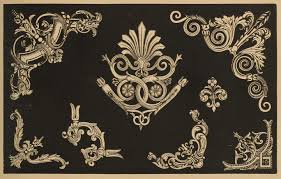
He bewails the baroque taste of the 1860s, derived from the era of French kings called Louis. Such tables, chairs, sideboards, beds: “There is not a straight line in their composition... this detestable system of ornamentation is called ‘shaping’.” He despises “scroll” ornament, suggesting that though it may be intended as foliage, it actually looks like a collection of the letter G (see picture). He dislikes imitations: “All articles of plate which represent in miniature objects of a different material – as barrels, tubs and baskets – are to be avoided.” Copies of oriental rugs won’t do because they are too perfect, but “I do not see exactly how veneering is to be rejected on ‘moral’ grounds.”

If people WILL prefer a bouquet of flowers or a group of spaniels worked upon their hearthrug to the conventional patterns which are adopted by the Indian and Turkish weavers, it is difficult to convince them of their error... The quasi-fidelity with which the forms of a rose or a bunch of ribbons, or a ruined castle, can be reproduced on carpets, crockery and wall-papers will always possess a certain kind of charm for the uneducated eye.

Modern wallpapers are “wretched specimens... gaudy and extravagant trash”. He recommends taupe, pale green, silver-grey and cream.  

It is a great pity that ladies who devote much of their time to the execution of the wretched [edging] patterns sold at ‘fancy-work shops’ do not exercise a little more discrimination in their choice... The so-called ‘ornamental’ leatherwork which a few years ago was so in vogue with young ladies... is utterly opposed to sound principles of taste.

He condemns light furniture (easy to rearrange as desired) as flimsy and feminine, and recommends high-backed settles to keep off draughts. “The drawing-room may be crowded with silly knick-knacks,” but libraries are to be a mancave. However, instead of a Grecian funerary urn, adorn the top of your bookcase with a miniature copy of a good Greek sculpture – the Gladiator, the Discobolos, Antinous.

When I look into the windows of some establishments devoted to decorative art, and see the monstrosities which are daily offered to the public in the name of taste – the fat gilt cupids, the coarse and clumsy mouldings, the heavy plaster cornices, and the lifeless types of leaves and flowers which pass for ornament in the nineteenth century – I cannot help thinking how much we might learn from those nations whose art it has long been our custom to despise – from the half-civilised craftsmen of Japan, and the rude barbarians of Feejee. (He got his wish – in the later 19th century there was a craze for all things Japanese.)

So, Eastlake, where are the positives? He shamelessly promotes his own furniture – blocky and heavy, lots of oak and strap hinges – and recommends an approach still followed by England’s upper-middle classes. Why not use an “honest” wooden bucket as a coal scuttle, instead of a cast-iron monstrosity with a view of Edinburgh Castle let into the lid? For knick-knacks, look either to the past (the Renaissance) or to current designers who copy good earlier models: Minton and de Morgan. He praises a type of curtain fabric whose stripes recycled actual horse-girths.


His ideas live on among the Upwards, who go for anything rustic (made by peasants from far, far away), or functional (French enamel coffee pots), or genuinely old (the kitsch of Eastlake’s day is now antique). What would Eastlake think of today’s “country” interior with artificially distressed (new) wood everywhere?

His ideas were taken up by the less cultured, and by the 1920s the Tudorbethan style was all over the suburbs, complete with heavy sideboards, Welsh dressers and appliquéd oak beams. The fashion was guyed at the Festival of Britain as “Gremlin Grange”, a warped cottage with twisted timbers and diamond-paned windows. What NOT to build, explained the designers, who were rehousing blitz victims in gleaming modernist estates and towers.

More here, and links to the rest.