Saturday, 13 April 2019

Modern Manners 2


My mother in law used to think it showed you were upper class if you were really rude to shop assistants - put them in their place sort of thing. She was a snob and it caused lots of arguments! (via Facebook)

The woman - never invited back - who told me she was a vegetarian, but didn't tell me that she was allergic to eggs. "I'll just pick it out of my quiche," (she actually said this), sighing alongside an accompanying smell of burning martyr. "I don't want you to go to any trouble."
(LW, paraphrase)

Visiting Americans were stunned at the rudeness with which the British upper classes addressed the unfortunates below them. (Great British Fictional Detectives, Russell James)

Stop making a fuss about how bad you are at pronouncing foreign names. Don't preface your attempt with a lengthy apology. It's deeply othering. If you encounter a name you don't know how to pronounce and you haven't an opportunity to ask, I strongly recommend you just do it. Thank people for their patience but crucially, just move on. At some point the jokes about being bad a pronouncing a name stop being about the pronouncer and become about how weird and foreign the name is. I know you feel uncomfortable and awkward and you don't want to get it wrong. But just move on. (@jeannette_ng)

Thanks for X product, which I’ve enjoyed using while committing Y task. Looking forward to seeing you during Z event. (Template for a thankyou letter from Daniel Mallory Ortberg)

An indignant friend tells me an anecdote about a woman on a bus who had put her bag on the seat (so that she was taking up two places). She didn’t move the bag even though he stood beside her without speaking for five minutes. 

Unbelievably, in the 70s posh people still changed for dinner. We stayed with some grand people who assumed we were as upmarket as they were. Mrs Thing was quite annoyed that we hadn’t brought skirts to change into. “Couldn’t Mary lend you something?” Mary was about five foot two and a size 12. I was five foot nine and a size 16. (If you're a tall woman, people have a strange blindness to your real height.)

I stayed with my parents at a hotel on Loch Maree where all the guests dined together. The proprietress said nothing to me, but approached my mother to say “Could you ask your daughter to wear tights in the evening instead of bare legs?” At least I was wearing a skirt! Bare legs were still taboo in the 70s, though they became OK in the 80s. In the 70s it was only OK to go without stockings if you applied fake tan that smelled of biscuits and turned your legs orange.

Don’t overload your fork, says the Royal Butler.

In the 17th century bell-ringers were penalised for wearing a hat or spurs in the belfry.

More here.

Thursday, 7 February 2019

What to Wear 9


"Sumptuary" laws forbade the wrong kind of people to wear sable or ermine, like the aristocracy. Elizabeth I proclaimed: None shall wear in his apparel: Any silk of the color of purple, cloth of gold tissued, nor fur of sables, but only the King, Queen, King's mother, children, brethren, and sisters, uncles and aunts; and except dukes, marquises, and earls, who may wear the same in doublets, jerkins, linings of cloaks, gowns, and hose; and those of the Garter, purple in mantles only. (And you couldn't wear pantofles of velvet unless you were the son and heir apparent of a Knight.)


In the medieval period,  “luxuria” – the temptation of fine clothes – was a sin. Don’t blame everything on the Puritans. Disdain of the wrong people buying too many luxury goods (materialism, consumerism, media-fuelled shopping frenzy) continues.

A lot of School of Oriental and African Studies students dress like they’re off on an episode of Time Team, fresh from private school. (Via FB)

Coco Chanel... proposed that her wealthy clients dress among other things like fishermen (in Breton tops), like male horse riders (in, shock, trousers), and like their maids (in, double shock, black dresses). Times Nov 2018 (See also espadrilles borrowed from sailors in the South of France, sailor trousers, gaucho hats, baseball caps, military caps, Basque berets, ballet skirts and ballet shoes.)

“This season’s tailoring” is always “softer”.

Judging by the Toast catalogue and others, a youngish Upward woman wears a baggy dress with a full skirt to below the knee, no tights or socks, and flat lace-up canvas shoes, probably in dark green. With it she wears no makeup, no smile, and her hair in a messy updo. If it’s cold, she puts on a droopy cardigan. The clothes are made of “good” materials like cotton, and cost rather a lot. She is trying so hard not to look as if she is trying to look sexy that she looks sexy, or that is the idea.

No Upward could wear sling-back shoes in the 60s – they were too sexy in a sluttish kind of way.

Hippy style in the 60s included necklaces made of dried melon and pumpkin seeds. You washed them in a colander, dried them in the oven and dyed them with food dye, before stringing them with a needle and thread. When times were hard, you could eat the necklace. It was a tremendous amount of work, and few people did it. The fashion came just before the full-blown hippy era – as teenagers we were desperate for finery, and our Upward parents looked down on children wearing jewellery. Fake pearls from Woolworths were beyond the pale. We learned how to make the seed necklaces from girls’ comics. It took up so much time, and you’d be doing something. And once hippy fashion got going, necklaces of dyed exotic seeds from stalls in Oxford Street were affordable, if not edible.

Blue collar, white collar – a working man couldn’t afford to wear a clean white shirt every day. Dark colours didn’t show the dirt.

Formal wear for women is physically restrictive. Wearing a skirt used to involve a tight girdle and stockings, and a tailored jacket in which you couldn't raise your arms or slump. Tailored jackets and blouses are still like this.

Samantha Upward might wear a tunic over jeans, especially if it’s flowery and from a wacky, bohemian Swedish designer. With it she wears boots over-decorated with tooling, flowers or coloured leather rosettes, that describe themselves as “vintage”. The ensemble makes her look like an elf. Mrs Definitely wears a tunic over leggings – it hides everything – but she’d look better dressed as an 1900s flower-seller in a blouse, skirt and hat.

Caro Stow-Crat only wears clothes that are recognisable garments with a long history: blouse, shirt, skirt, trousers, cardigan, jacket, jumper, coat. They may have changed their shape several times over the past century or so, but they have endured. She avoids the “detailing” that manufacturers love to add to clothes for the older lady. And she never wears a tunic.

More here, and links to the rest.
Wednesday, 6 February 2019

Choose Your Words Carefully 8


Class is a thing of the past, people keep telling me.


I have been told that I was too Northern in a show – a Northern drama, actually – and I was told that I needed to tone down my accent because a character with a well-paid job wouldn’t want to marry me. (Mandip Gill)

David Hockney said that when he arrived at the RA in 1959 from Bradford his fellow students mocked his northern accent. “They’d come up and say, ‘Trouble at mill, Mr Ormonroyd?’”
 (Times Feb 2019)

A couple of minutes into the interview, the man interviewing me said he was stopping the interview. He told me that I was applying for a job teaching English but I wasn’t speaking it properly myself! (A man from Rossendale applies to do a PGCE teaching qualification. Reclaim.org.uk)

I've met lots of people who've had elocution lessons, especially northerners. They are often perceived as 'posh' by others. (Dr Sandra Jansen of the University of Leipzig)

How ‘well’ we speak can have great social currency... Studies have even shown that speakers of prestige language forms are judged more handsome and physically attractive. (Language Myths, Laurie Bauer and Peter Trudgill)

There are different varieties of a language associated with different regions and different social sets. The way you talk will show what group you belong to, and people will decide on that basis how to treat you. (BBC Online)

A BBC manager once told presenter Steph McGovern she was too common to read the news.

Sir, Years ago I took a screen test before appearing on BBC TV’s Antiques Roadshow, on which I subsequently appeared as a ceramics specialist for nine years. I spoke to camera about an object, and when I had finished the director, aghast, said: “My God, you sound upper-class.” Things do not appear to have changed (“BBC is ordered to reveal staff’s social class”, Sep 15), and it is high time the BBC realised that discrimination does not only happen de haut en bas, and that all discrimination based on factors that a person cannot change is pernicious. (Sally Kevill-Davies, letter to the Times, September 2017)

Not the Whole Story is a delightful memoir. I was going to describe it as “gorgeous”, but that is one of the modern vulgarisms to which Angela Huth objects. There is a list of these at the back of the book, which made me feel every inch of my own vulgarity. “Munching” and “leafy” are both sniffed at, as are “floral tributes” and “passed away”, but fair enough — as a former deb and hobnobber with royalty, you’d expect Huth to be la-di-da. (The Times)

The Headmaster of Harrow School says his pupils speak mockney well into adulthood in an attempt not to appear posh. (Posh young people have done this for years – listen to Princess Diana.) (Jan 2019)

In Georgette Heyer's detective story Envious Casca (1938), common characters say “I took the liberty of saying” and “I happened to pass the remark”. Another (a pretty blonde), says: As a matter of fact I very nearly went to COLLEGE, and I should have, only that it seemed the most frightful waste of time!” She peppers her speech with “foul” and “ghastly” and “frightful” and “lousy”, to the other characters’ disgust. She even says “Oh, I do think you’re the limit!” And “I think it’s all completely deathly!” She also claims to be “highly strung”. Roydon, a playwright, is referred to by the butler as “a person by the name of Roydon”. The family call him “this Roydon fellow”. A valet is referred to as “this Ford”. And someone says of Roydon: “People not out of the top drawer are always inclined to be touchy.”

In Dodie Smith’s It Ends with Revelations (1967), two young girls are trying to update their speech: ‘We’re trying to oust “sort of”, “I mean” and “you know” from our vocabularies.’ They’re also distressed, when listening to a recording, to find that they “mince” and pronounce “no” as “noe”.


Received Pronunciation (RP) has changed: here’s Jack de Manio telling us how to speak. Don’t be slovenly or affected! But nobody says “lib-rar-y” any more. He almost says flexibiliteah and
kee-anteen. Clariteah and accuraceah in delivereah. You’ll naytice... He warns against supstance and dretful – these have vanished.

Radio 3 used to be the last holdout of RP. Announcers could never speak off the cuff, they had to read out misinformation from cards (“Beethoven anticipated Wagner”). Women announcers were picked for their deep, even voices (almost as good as a man). Now they all ramble chattily, failing to enunciate and dropping their voices at the end of sentences, and I find it hard to understand what they're saying.

Caro Stow-Crat talks about people going “puce” with rage or embarrassment, rather than red. Puce was originally a pale red, like rosé wine, but these days it is used to mean – well, the colour people go when angry. Gammon.

January 2019 Eileen Weybridge and Jen Teale are talking about “Project Fair”. To Caro it’s “Project Feeyah!”. Samantha Upward compromises on “Fyair”.

Jen and Eileen say pryvacy and proh-ject; Sam and Caro say privvacy and projject with a short I and O. Teales and Weybridges usually shorten vowels, e.g. oggle for ogle, but sometimes lengthen when they should shorten. Samantha has a crisis of conscience every time she has to say the word “extol” in church.

A posh way of showing contempt is to put the word “now” in an odd place: It has to now be called… The question now is... We then go on to… (Passage to India, E.M. Forster) I now thrash him within an inch of his life. (Howard’s End, E.M. Forster)

Teales and Weybridges take an “Aspro” for a headache (unless they’re the kind who “don’t take tablets”). Stow Crats and Upwards take an “aspirin” because the word is generic and they can’t mention brand names because it means someone is trying to make money and that’s “trade” (Caro) or “capitalism” (Samantha).

The Stow-Crats have attics – the rest of us just have “lofts”. Mr Definitely makes a killing doing “loff conversions”. For Weybridges, the spare room is the “guest room”, where you find special “guest soaps” and “guest towels”. Caro shudders when Jen calls a roast potato a "roastie" and pronounces the t in often – but admits she's an awfully good sort.

Superpose for superimpose is very Weybridge. Elderly Weybridges used to pronounce profile as “profeel”. In Shakespeare’s Quatercentenary (1964), most people pronounced it “courter senteenary”. A few middle-aged Howards pronounced it “kwatter centennary”. It was quite annoying.

Hello Dahlings! Just been to @royalacademy Summer Exhibition dontcha know.” Someone on Twitter is trying to sound posh. For the record, posh people do not call each other “darling” the entire time. However, “darling” is the only endearment they can use. They only use “dear” when delivering searing put-downs. And they would never call anybody “dearie” or “love”. “Doncher know” is extremely old-fashioned upper-class speech from the Edwardian era.

For a long time, my mother wouldn’t talk about people “watching television”, they were always “looking at television”. She also called programmes "films". But then she discovered The Antiques Roadshow. Now elderly Upwards talk disparagingly of "Instachat" and "Facegram".

If Upwards turn up at a friend’s for lunch and the family has clearly just had a screaming row which is still simmering, the visitors later report that “there was an atmosphere”. This atmosphere of things unsaid and seething resentment may persist in a house for years, while everybody goes through the motions and pretends not to notice anything. But that's privilege for you.

More here, and links to the rest.


Saturday, 6 October 2018

In an English Country Garden


Those aren’t plastic flowers, those are “faux botanicals”.

Weybridges know the Latin names of house plants. Fiona Stow Crat gives hers nicknames. 

An Escape to the Country participant says his ambition is to have enough grass for a sit-on lawnmower.

No good house should have to suffer the indignity of being covered with climbing plants. It is architectural bad manners almost on a par with plastic doors and windows. (Letter to Times, May 2017)

I was once sternly told not to plant Russian vine in my garden – so I did, and it flourished. I couldn’t understand why my mother wouldn’t plant any beautiful, romantic Virginia creeper, found all around us in Surrey climbing up half-timbered Arts and Crafts villas. She also vetoed pampas grass (suburban) and my father outlawed nasturtiums (too orange), but she grew them anyway.

In the 70s a clump of pampas grass in the centre of your front lawn was supposed to signal the home of wife-swappers. (What did other wife-swappers do? Just come and ring your doorbell?) The pampas grass would be in the middle of a perfectly kept lawn in front of the house, with no fence or wall. This was thought to be American and hence utterly naff. If you didn't have pampas grass, you probably had a laburnum. (What happened to them? Health and Safety? The seeds are poisonous.) Laburnums were naff, as were any "weeping" trees including willows and silver birches. In fact silver birches were verboten whether they wept or not. According to Nicky Haslam, hydrangeas were posh in Edwardian times.

Garden no-nos from the Times 
Times writer Anne Treneman has inherited a garden – she bought it from someone called “Malcolm”. Unfortunately it contains:

pampas grass
Leylandii
hostas
poisonous plants
orange flowers

She also frowns on:
tiny Zen gardens
invasive bamboo
anything that grows too big (Don’t plant a Scots pine in a  suburban front garden)
climbers (that strangle your TV aerial)


To the Brits, horticulture is about the gardens of stately homes, not breeding disease-resistant bananas. Cecil Beaton (The Glass of Fashion) makes the point that flowers were part of your interior décor, and you renewed them every week, or every few days. If you had “grounds”, your flower garden was designed to produce flowers to decorate the house. Per Nicky Haslam (Redeeming Features), this is called the “cutting garden”.

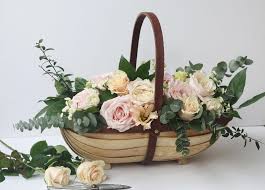
Until the mid-60s, women still “did the flowers”. In a large country house, either the wife or one of her daughters had the task of picking the flowers and taking them (in a wooden trug basket) to the “flower room”, where there was a big sink, and vases on a slate shelf. Here she arranged bouquets for the drawing room, dining room and hall, and possibly guest bedrooms and her own.

In the 50s and 60s women went to flower-arranging classes (a relative was very witty about being told to put “blooms” in a “container”). They dabbled in ikebana, and read Constance Spry. Post-war domestic writer Ethelind Fearon (The Reluctant Gardener) advises on which plants to grow and how to turn them into “arrangements”. This sometimes involved clipping leaves into more aesthetic shapes. And then women got jobs, and we did without flower arrangements, or substituted trailing variegated ivy (60s) or spider plants (70s).

When Upwards, forced out of inner London, move to Stratford or Walthamstow, all they can find are houses with “state of the art” kitchens and gardens that have been “cleared”. They immediately start making the garden look wild and untidy again. If they can afford it, they “rip out” the gleaming cabinets and replace them with dangerously rocky 50s “kitchenette” larders and a pine table. If they’re really well-heeled, they pull down the extension and turn it back into a patio.

Monty Don in the Times on John Seymour’s self-sufficiency books: Nobody apart from “a few bedraggled hippies on wet Welsh hillsides” really wanted to fend for themselves. (Self-sufficiency also required you to use your children as slave labour. Though didn't the Downton Abbey inhabitants live off their estates? They were self-sufficient in venison, peaches and everything else – easy if you have enough land and can pay gardeners and farm-hands.)

‘Well, well,’ said Colin. ‘Some front garden!’ 

It was indeed a model of surburban perfection in a small way. There were beds of geraniums with lobelia edging. There were large fleshy-looking begonias, and there was a fine display of garden ornaments — frogs, toadstools, comic gnomes and pixies. 


‘I’m sure Mr Bland must be a nice worthy man,’ said Colin, with a shudder. ‘He couldn’t have these terrible ideas if he wasn’t.’
(Agatha Christie, The Clocks)

More here, and links to the rest.


Thursday, 4 October 2018

What to Wear 8


Caro Stow-Crat says: “Please, no fancy dress after 40. Though Harry did once go to a fancy dress ball as a bishop...”


A welcome erosion of class structures has seen top hats relegated first to the top shelves of cupboards and wardrobes, and then donated to become a staple of Amateur Dramatic Club costume collections. (Lucy Adlington,
Stitches in Time) Thomas the Tank Engine’s Fat Controller (Sir Topham Hatt) was originally the “Fat Director” – a 20s caricature capitalist in a morning coat and top hat, grown fat on the profits of a private railway company. When the railways were reprivatised, why didn’t he revert to being a director? He's still an outdated stereotype.

Caro wonders when a bowtie became a “dicky bow”? A dicky is a fake blouse consisting of a Mao collar and enough material to show under a V-necked jumper. It's a useful way of using up remnants, and will delude your friends that you own more blouses than you actually do. A “dicky bird” is what vulgar people call a bird.

Samantha says “I refuse to buy my grandchildren clothes covered in writing and logos”. She buys them clothes at Muji and Uniqlo. Sharon Definitely buys her daughter (Madison) pink T shirts that read “Little Lady” but also “Girls Can Do Anything”. Her son Jayden dresses in scaled-down army uniform.

Lower middle-class Jen Teale uses shoe deodorisers, Caro chucks smelly trainers, but Samantha insists on wearing them out. She may Google for an old-fashioned (cheap) home remedy (baking soda) that doesn’t work. 

“Dress for the job you want, not the job you have.” This advice made sense in the days (80s and earlier) when a secretary wore a blouse and skirt, while the lady boss wore a suit.

I’m old enough to remember when we called face veils “yashmaks” and made jokes about them. Perhaps those old white men who moan about “political correctness” could cast their minds back. Nobody forced us to stop joking about yashmaks, we just stopped. We don’t give small children replica guns any more, either. Or sweet cigarettes.

Young people holiday in the far East and come back with batik sarongs. (In my day they went to India and came back with kurtas and kaftans – but not saris.) But no Upward goes to Whitechapel or Ridley Road market to buy a long flowery dress as worn by Muslim ladies, or a glittery shalwar kameez – or even a cotton shalwar kameez. They’re very cool in hot weather and are perfect for the office. Likewise, Boris is appalled by niqabs but not by a Carmelite nun’s outfit. The Times (August 2018) shows “manxi” dresses that are very like a Muslim woman’s dress, but no connection is made. Is this crossover? Cultural appropriation? Caro wears a genuine pashmina to the opera, over an oxblood taffeta evening dress with a wide skirt. Her great-grandmother wore a genuine Indian paisley shawl.

When I arrived at university in the 70s my sunglasses with pale pink frames puzzled other students. I seemed to be middle class – didn’t I know that the colour pink was common? And pink plastic! I also wore a pink mohair jumper – I was going through a 50s phase. I was ahead of the trend – lurid mohair jumpers were a punk fashion in the later 70s. And this was in a decade when we were supposed to be breaking down barriers of all kinds and creating an egalitarian society, free of all prejudice. They dressed entirely in blue denim or brown corduroy. (Can you still get brown denim? They never seemed to grasp what “prejudice” meant, either.)

In 2018 Teales wear 7/8 jeans, white T shirts and cardigans or jackets in a subdued, plain colour. Usually blue, navy, and grey. They look almost Boden. They achieve this look by buying cheap clothes and discarding them as soon as the material goes sad and shabby. They ruthlessly “edit” their wardrobes, and wash everything after one wearing. They iron their T shirts. Upwards, on the other hand, have “favourite” pieces they are sentimentally attached to and persist in wearing them however grey, bobbly and sagging. They fail to notice that modern fabrics don’t last like the old-fashioned kind. Teale clothes, being featureless, have no associations and are just replaced by more of the same.

More here, and links to the rest.

Canny Upwards in the 70s used Catherine Milinaire's Cheap Chic as a style bible.

Wednesday, 1 August 2018

You Are What You Eat 13


Dog friendly vegan doughnut café opens in Hackney (headline)

About 30 years ago, Upwards were very scornful about the proliferation of coffee shops in places like Victoria Station. Suddenly you could get a real cup of coffee and take it away in a paper cup for your journey, instead of sitting there for an hour without even a glass of water. They swore they would never patronize these establishments because, well, bang would go sixpence!

Takeaway lunches are for one, takeaway dinners are for two. Eileen Weybridge moans that everybody gets takeaways “these days” and what will happen to home-cooked meals and kitchens? She forgets that the home-cooked food took all day to prepare, which was fine if you were a woman married to a “breadwinner”.

Upwards used to claim they’d had “ham and salad” for lunch. This meant a small portion of ham and salad, accompanied by thick slices of bread and butter, and followed by semolina pudding with jam. They’d really eaten the makings of a ham sandwich, but couldn’t admit it.

Even though the Spectator points out that the statistics are unreliable, Upwards and Weybridges are very worried about working-class children being obese. It  must be those fast-food outlets in poor areas, and the “processed” food poor people eat.

Food banks ask for tinned food because most of their clients have few cooking facilities and nowhere to store fresh food. When people are starving because their benefits have been cut, worrying about obesity is a luxury. But it’s such fun sneering at people who “shove something in the oven because they can’t be arsed and they’d rather watch Eastenders”, isn’t it? (Via Facebook)

@Louisathelast on Twitter led a definitive exchange on why poor people eat cheeseburgers. Here are the highlights:

When I was at my poorest, I ate a lot of McDonald’s. But isn’t eating out more expensive? Well... More expensive than the absolute cost of a cheeseburger and fries you make from scratch at home, with bulk ingredients? Yeah. But more expensive than the cost of all those ingredients put together? No. And that’s the *real* cost, when you are poor. When you have $5, you do not have the money to buy ground beef, cheese, buns, seasoning, condiments, potatoes, and oil for frying the potatoes. That’s more like...$15-20, assuming you don’t have some staples to start with. And that you’re buying the absolute cheapest options. So, you have $5. But wait, you could save it up! No, you can’t, because you’re hungry now.

She adds that you don't have the eight hours needed to process and cook (cheap) dry beans, because you're working. Good-for-you veg like baby carrots are not filling enough. And it's hard work cooking three meals a day. And there are only so many times you can face pasta and sauce.


@raznochintsy adds: At my poorest, I lived off potatoes. I could get a 10lb bag for 99 cents. I’d get leftover packets of sauces from people at work to “dress” them. George Orwell reported that when you live on bread and marge you can’t do anything but sleep or read old Sherlock Holmes stories. He was also quite brusque with people who say the poor can live on brown bread and carrots.

I recommend rice with Ainsley Harriot soups...

In north Norfolk I found myself being served Nescafé, like it was 1991 or something.
(Sathnam Sanghera)

What’s the difference between a café and a caff? A museum member's room is definitely, a café, but who really wants to eat rocket and chickpea salad? It costs very little to make, and is sold at a huge mark-up because it’s “upmarket” food. What makes it upmarket? The non-native ingredients. The bread is “special” – sourdough, or baguette, or ciabatta (German, French, Italian). It has to be “crusty”, and too thick, and is usually rather stale. And any fillings (cheese, ham, falafel) come with rocket, peppers or sun-dried tomato. As well as being over-priced, it’s old-fashioned and dull.

Rowena Upward is opening a caff.
She may diversify into a street food stall – none of them sell British food. On the menu:

Black leaf tea brewed in an urn
Mellow Birds coffee, made with hot milk
Leeks in cheese sauce
Crusty bread and paté
Stew
Coronation chicken
Quiche Lorraine
Shrimp wiggle
Cheese potato pie
Bacon roll
Toad in the hole
Steak and chips
Mashed potatoes
Gravy with lots of Bisto
Liver-sausage sandwiches on white sliced bread
Heavy cheesecake with raisins
Crustless andwiches served with cress and a few crisps

“Traditional home-cooked British food!” chirrups Rowena.

“But that’s supposed to mean fresh, free-range and locally sourced!” wails Samantha. “And given a modern twist with rocket, coriander and chillies!”

“You can keep those chillies out of my dinner!” says Mr Definitely. “Steak and kidney pud – that’s proper British food!” He's outraged that the Co-op now put chillies in beetroot. "They're supposed to taste of vinegar!"

His daughter Sharon adds: "Heinz have added chilli and cumin to tinned ravioli. Well, really, I mean."

If there’s a new kind of exotic cuisine that I simply must try, that comes with its own unpronounceable spices, it will turn out to be HOT. Upwards have to pretend to like very very hot food even if they don’t, and I really ought to stop letting the side down.

Though we are supposed to like “delicate flavours” (and weak tea). We pretend that we only eat food because we like the taste. As somebody said, where are the chips? (And the answer is “in a miniature shopping trolley”.) When not exclaiming over fugitive tastes, we are supposed to like chillies that burn off the roof of your mouth. What we are not allowed to like is anything that tastes salty, sweet and vinegary (all once, please). If you put tomato ketchup on everything, your palate will become “vitiated” and you won’t be able to taste the refined flavours that are the real point of eating. There is obviously a rhetoric here of superior people with “finer” sensibilities.

Upwards write endless articles in the broadsheets about canny ways to make your children try new foods. Sharon Definitely says “If Madison wants cheese chips, she gets cheese chips.”


The Guardian tells us that white supermarket bread is not as good for you as “artisanal” bread. Rubbish, says botanist James Wong (pictured), same nutrition, same calories. This is just snobbery.

Affluent consumers are almost twice as likely to think they know more about nutrition than lower earners. But this doesn’t correlate with better-informed choices. In fact, higher earners are more likely to be influenced by misinformation and pseudoscience. (James Wong)

Humankind’s tendency to randomly attach moral labels to foods (with the inference that immorality is at the root of ill-health) goes back far longer than today’s food fads re gluten, dairy and “processed foods”. (James Wong, paraphrase)

Upwards dislike anything with “mass” in the title. Surely only exclusive food is good for you?

Mass-produced food = Unhealthy? The nutritional value of food is determined by chemical make-up, not its location or scale of production. Essentially all fruit and veg (inc organic) are mass-produced.(James Wong)

In Hong Kong, Ferrero Rocher are known as “gold sand” and they quickly became a marker of social class. (Thrilllist.com)

James Wong's latest book is How to Eat Better.


More here, and links to the rest.

Monday, 18 June 2018

Class Is Dead, Long Live Class 4


Stand-up comedian @SamWhyte asked Twitter: "When you were a kid, how did you know someone was a bit posh when you went round their house? So far we've got more than one type of cheese in the fridge..."


I've divided the answers into social strata.

Weybridges
Served food without a pile of bread and marge for if you were still hungry. (In our Upward home, all our meals came with bread and butter on the side, but nobody ever ate it. It was just make-work. And we continued with the pantomime for years.)

Soda stream. (I could never understand why my Upward parents wouldn’t get one. They didn’t want to spend the money, and they rationed sugary drinks. Even Kia-ora orange squash was only allowed at birthday parties. They thought that if we didn’t get much sugary food, we wouldn’t “acquire a taste” for it, and we’d “acquire a taste” for grown-up middle-class food like tough mutton and over-boiled cabbage. Liking sweet food is common – but it meant there was something they could withhold. Also they despised electric gadgets, though they did get a “waste disposal unit” for the sink, which made a horrible noise and ate a lot of Georgian silver teaspoons. I’m sure my mother used to push potato peelings down it with her fingers while it was on.)

Bidet, two sinks to wash up in, salad spinner.
Fitted carpets. Soft toilet paper. Colour TV.
Not sure if it was the master bedroom ensuite or the stone lion on a plinth in the garden.
One word - Lladró.
My friend's Dad had a study and always asked me what career I’d chosen - I was 10.
A serving hatch.
Fish knives and cake forks.
Fancy biscuits for every day.
Pot pourri, mahogany TV cabinet, VHS spinning shelves.
My friend was called Chris, until you were in his house and he was called Christopher.
Guest soaps in the shape of shells and a phone in the parent’s bedroom.
Phone table, guest room, ottoman, front garden, utility room, breakfast room.
A front room called the "morning room".
Taking your shoes off in the house.
Home-made puddings every day.
Keeping the Radio Times in a faux leather folder with ‘Radio Times’ on the front in gold letters.
Coca Cola when it wasn't a birthday party.
Choc ices in the fridge, a whole box of crisp packets, being allowed to take food between meals.

Soap on a magnetic arm. I often think I dreamt this, but the bar of soap had a little disk of metal pressed into it, and it hung off a magnetic thing.

Definitely
In the 70s our back yard (with outside toilet and coal shed) was converted into an extension. My mum still calls it her 'East Wing'.

When I was a kid, the posh ones wore 100% shop-bought clothes. It might seem amazing now but things like shorts, sweaters, socks, scarves and dresses in the 1950s were just about all home-made among most of my class-mates.

Supper is a bowl of Frosties. (I once stayed with an aristocratic family who lived in a stately home. But they had cereal for supper, in the kitchen, and then watched TV. I tried to persuade my parents to do the same, but they wheeled out the line about “learning how to behave in formal situations”, and “setting a good example” for my eight-year-old brother.)

I was born in the 1940s and lived in privately rented housing (with an outside toilet). But when I suggested to my mother that she put her name down for one of the council houses with all mod cons the snobbery kicked in, and she said "only common people lived there"... It was more to do with the infinite gradations of class, and whether people sounded their H's or not. My mother's mother was from the upper servant sphere, and I think she saw council-house tenancies as for the labouring classes. It was quite intricate.

White pepper in its original container from the shop.
Dairylea was considered posh in our street.
We had Walls Viennetta for pudding! Mint flavour. (Lucky things.)
Variety cereal boxes “were considered profligate in our household". (And ours.)


Upwards
A hardwood stereogram with a glorified giant toast rack next to it full of classical albums.  A very small black and white TV for those rare occasions when there was a good documentary on BBC2.

Playing classical music while eating homemade lasagne with a side salad at a dining table in a room with no TV on. Followed by homemade tiramisu for dessert. Oh, and it was called dinner, not tea or supper.

Using a cup and saucer, dads went to work in a suit to an office not down the pit, wine with evening meal, went abroad for holidays not to Hornsea or Ireland, rugs on polished wood floors. (Guilty as charged – though we did holiday in Ireland.)

Parents that engaged you in conversation. (Others say: “They talked at meals, instead of sitting in silence.”)

A spice rack. We only ever had salt in the cupboard. (The herbs were all dried, and these days Upwards grow their own.)

A separate immaculate living room that you weren't allowed to enter, let alone play in. (My parents tried this one, without much success.)

Engraved napkin rings. “Visitors were assigned a napkin ring from the guest set, kept in a special velvet-lined box in the sideboard.”

Dinner didn’t arrive on your plate, there were serving dishes on the table or a hostess trolley, with serving spoons and napkins. At home I just got given a plate of food. Served dinner at the table – owned tureens and stuff. (A lot of extra work, and assumes someone else will do the washing-up.)

I remember being completely bemused by the concept of a milk jug. 
Nobody left the table before everyone had finished. (Someone comments “I had to suffer that too.”)
Dishwasher, and they put whole peppercorns in the dinner.
Kids who referred to mum and dad as their ‘parents’ and their nan as ‘gran’ or ‘grandma’.

No visible religious iconography.
Imperial Leather soap.
Gold-top milk.
Brown bread.
Original art on the wall. (Sometimes by relatives or friends.)
An old upright piano.
Large, well maintained back gardens.
Melon as a starter.
Grapes on the sideboard.
A landing half-way up the stairs.
Garden furniture made of wicker.
Gravy boat on the table.
Salad in a bowl, without a sliced boiled egg but with vinaigrette.
Mayonnaise (home-made, not Hellman’s).
Telly in another room.
 “Supper.”
Not opening Christmas presents until after lunch. (Probably to teach children “deferred gratification”.)
Multiple kids who don’t share a room.
Downstairs and upstairs toilets.


Teales
Air fresheners plugged into the wall. A knitted lady hiding the toilet roll in the bathroom. Not being allowed ketchup at dinner because it’s too ‘common’ and finally not being allowed food upstairs.

A "formal dining room" they never normally went into. (One family only used it for Christmas.)
Decorative plates hung on the wall.
Dream topping and angel delight for pudding. 
A transparent plastic mat over the carpet the length of the hall.
Quiche and laminate flooring.
A 32-piece shiny cutlery set complete with fish knives in a purple velvet box.
Pampas grass... and it didn't smell like people lived there.
Video cassettes kept in cases that looked like hardback books.
Good outdoor garden toys.
Double glazing and radiators.
Doilies, antimacassars.
Mid-week fizzy drinks, a plastic wipeable table cloth.
A non-standard bathroom colour.
An immaculately tidy house


Nouveau-Richards
My mate lived in a house that had a name. His dad had a bar with a full-sized snooker table in it, and a woman who just did stuff around the house but didn’t live there. 

Colour telly in more than one bedroom.
Shag pile carpets that got hoovered every day.
Globe drinks cabinet.
A silver carriage for the After Eights box.
One whole room of house devoted to an electric organ – or a complete orchestra of instruments.
Two staircases and a housekeeper.
A room called a "den".
Onyx table lighter.
Leather sofa. Stairs you could see through. Shop cake.
A marble chess set on a wooden board always set ready to go but nobody ever dared play it.

More here, and links to the rest.